
Of all the building material samples we make books for, carpet is actually the easiest to mount.
Tile is heavy and stone is hard, so if a slot is even slightly off, the sample won’t go in. Carpet is soft. Thin carpet goes on with double-sided tape, and thicker, heavier carpet takes a few dots from a hot glue gun, and it stays put on the board or page. So when you’re planning carpet sample boards (the usual term in the US) or carpet sample books (more common in the UK), the real question isn’t how to stick the samples down. It’s two things: what format you want, and how big and heavy the samples are.
Here’s a typical job of ours. The client was a hotel carpet company in Saudi Arabia, and the order came to us through a trading company. They wanted a fold-out sample book. The cover was printed in Arabic and English, with a photo of their carpet installed in a hotel on the front and the product specs on the back, such as the pile blend (wool to nylon) and the pile weight per square meter. The inside pages were left blank, and they mounted the carpet samples themselves.
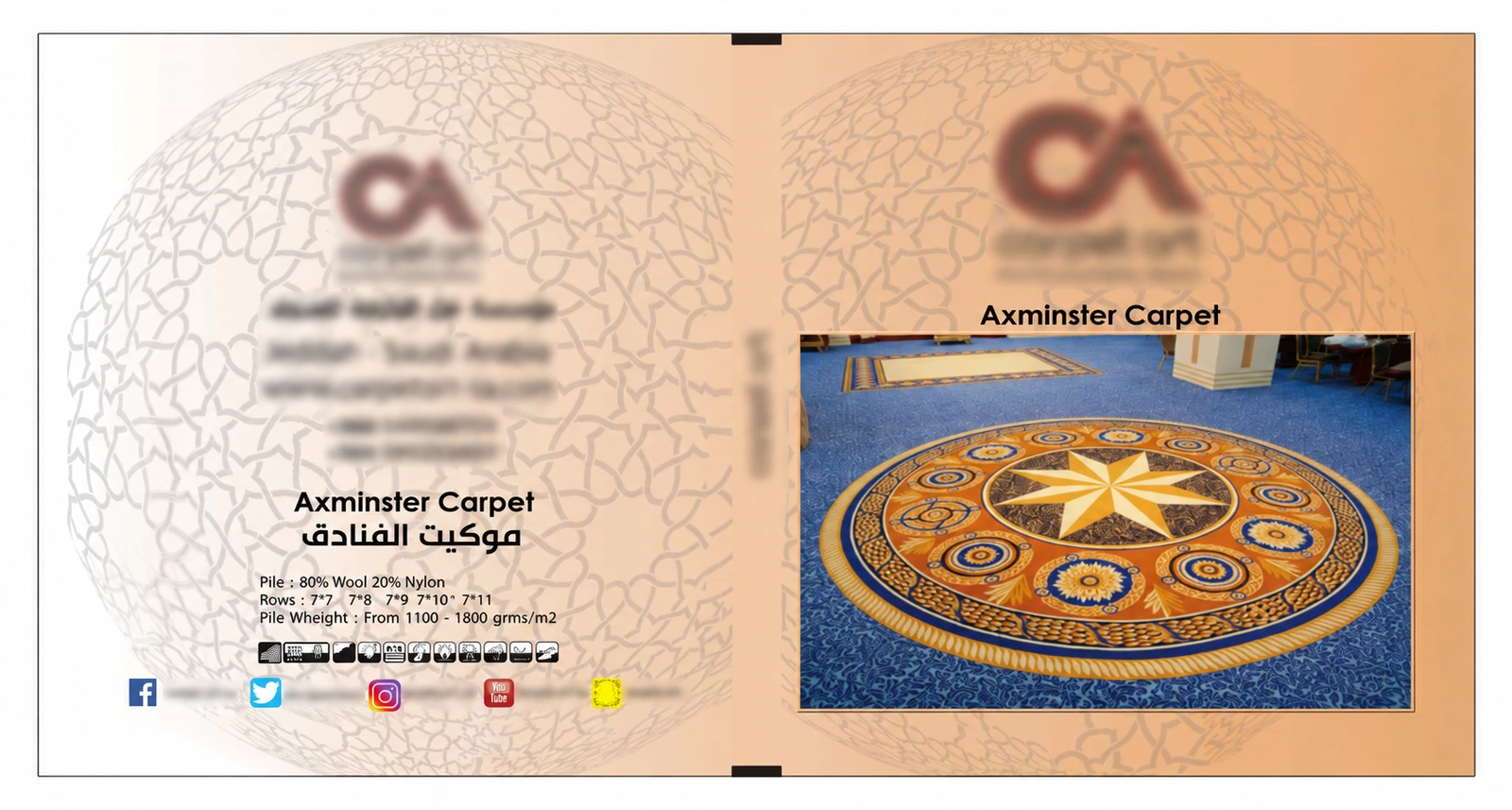
We didn’t ask how they planned to mount the samples or how big the pieces would be, and there was no need to. They know their product better than anyone. Our job was to get their sizes and requirements right. They later came back and reordered the same book. For us, that’s the most honest feedback there is.
Below: how to choose between a board and a book, how to mount carpet samples, who decides the sample size, and a few things that are easy to miss before you order.
Carpet Sample Boards vs. Carpet Sample Books: What’s the Difference?
A sample board is a rigid board with all the samples laid out on one face, so everything is visible at a glance. We don’t make the large wooden carpet sample display boards that hang on showroom walls or slide into display racks. Our sample boards are made to be held: you can hand one straight to a client, and they also work alongside a fold-out or a box. A sample book closes, so it’s made to travel. Your sales rep carries it to a hotel, a design studio or a job site and opens it in front of the client.
Carpet sample books come in a few constructions. Choose by how many samples you need to show and how heavy they are:
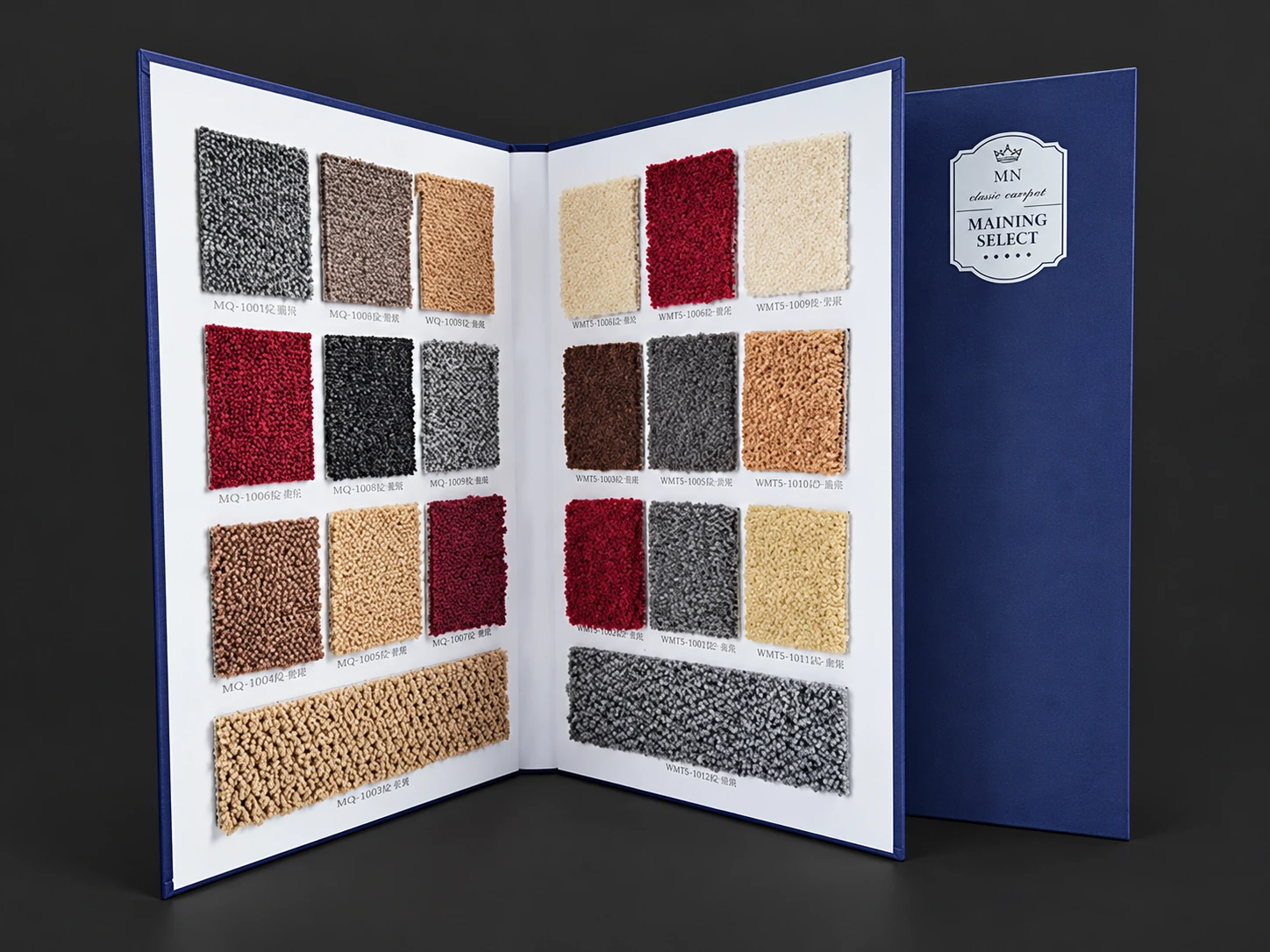
- Fold-out board: Built on greyboard, with three, four or five panels. Opened out, it’s usually around 90 cm (about 35 in) long, and it can go to a little over 1 m (about 3.5 ft). Dozens of samples are no problem. The Saudi order was a fold-out. Closed, it’s one book. Opened, it’s one long row, so the client can compare colors side by side.
- Sample binder: The easiest option if you have several collections and add new styles often. You only swap the pages, and the binder itself doesn’t need to be remade. For heavier samples, the pages are two sheets of white card laminated together, and for heavier still, they get a greyboard core. The one catch: the bigger the binder, the harder it is to flip through.
- Sample box with a handle: The most premium option, and the card inside is what makes it work. Each carpet sample is mounted on its own white card, and that card is the sample’s spec sheet. It can carry your brand, collection name, style code and color, plus a short product description, pile composition, pile weight per square meter, and where the carpet is meant to be used. A client picks up one card and has the sample in hand and the specs in front of them, with no catalog to dig through. A rigid white card about 1 mm (about 0.04 in) thick holds even heavier carpet. The cards are cut slightly larger than the samples, and the box is divided to fit the cards: two stacks side by side, four stacks, or one large and one small compartment. It all depends on your samples. Stacked together, the cards stay snug, so nothing gets crushed and nothing slides out. A ribbon runs under each stack, so one pull lifts the whole stack out and the client can go through the cards one by one.
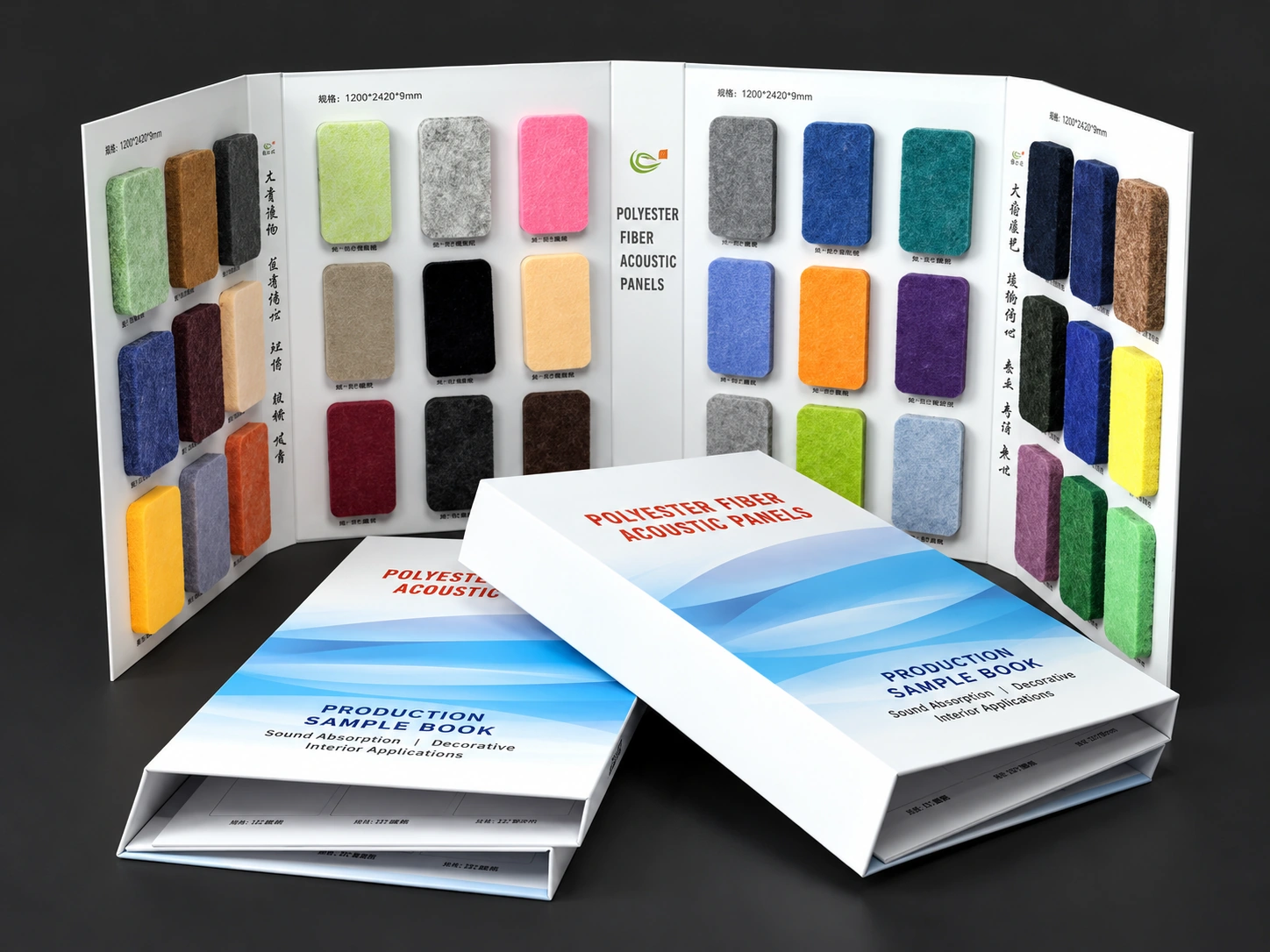
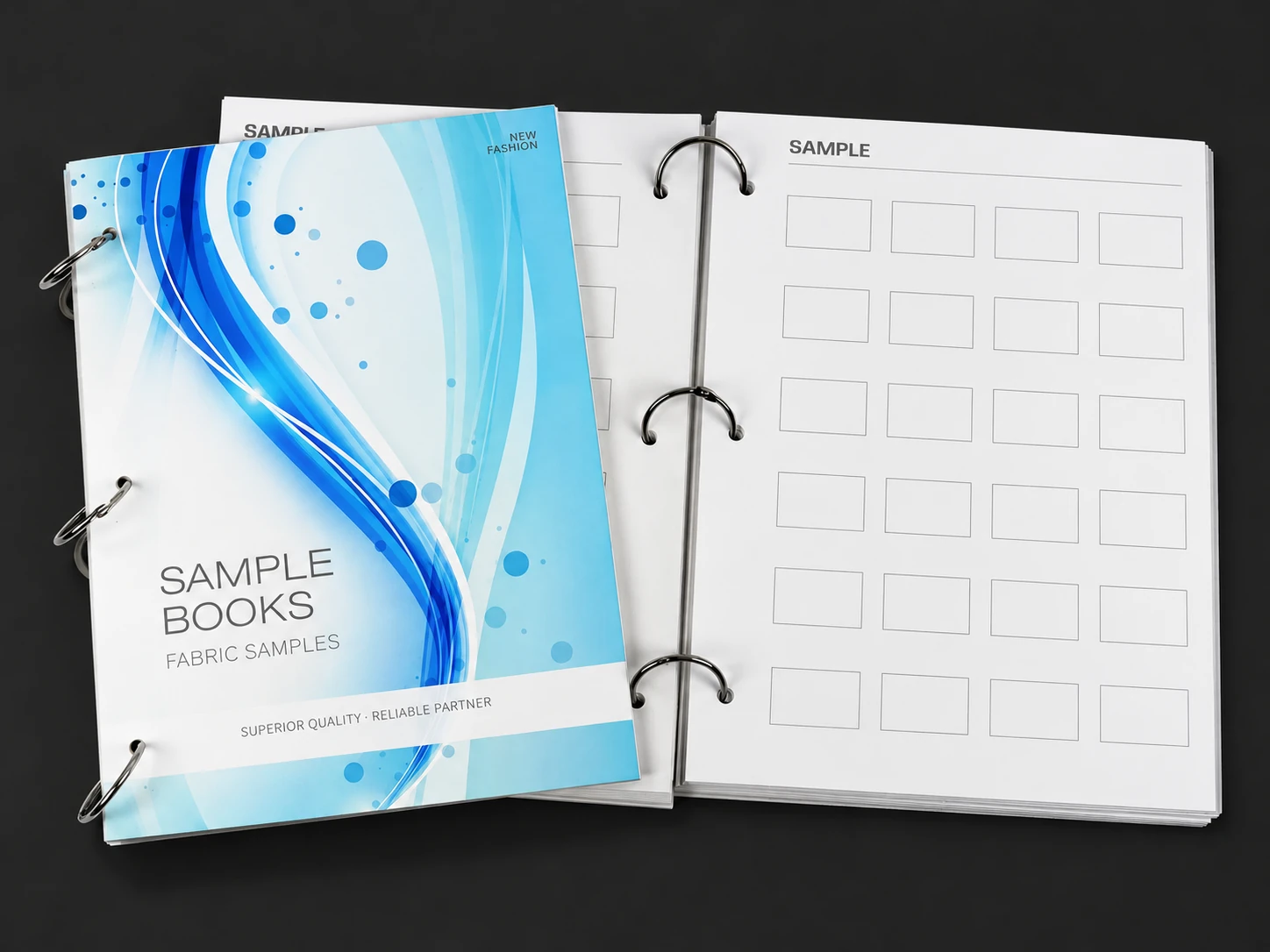
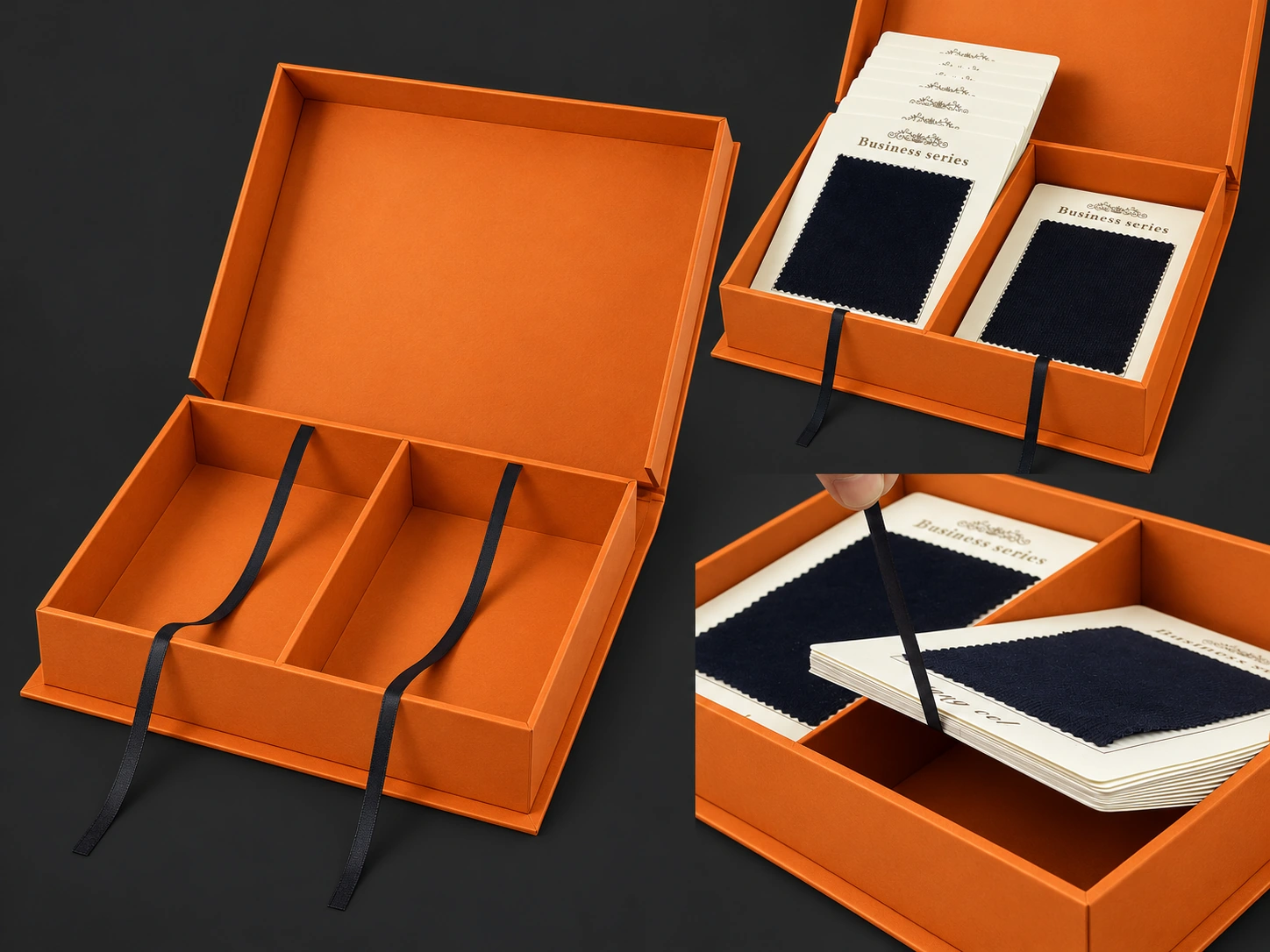
The pages of a fold-out, a binder or a sample board can be made two ways: flat-mounted, where the sample is stuck straight onto the page, or slotted, where the page has an opening and the carpet is pressed into it. More on both in the next section.
Old-style carpet flip books, where a stack of swatches is bound at one end and flipped one by one, have their critics even among the big carpet makers. Interface’s carpet sample book patent describes flip books as bulky and not particularly stable. A fold-out or a binder opens flat, so the samples don’t pile on top of each other, and it sits much steadier in the hand.
In short: if you want clients to see everything at once and compare it in their hands, choose a sample board. If you’re carrying lots of samples out to meetings, choose a fold-out. If your collections change often, choose a sample binder. If you want a premium feel and want clients to handle the samples card by card, choose one of our sample presentation boxes.
How Do You Mount Carpet Samples on a Board or in a Book?
Flat-mounted pages use adhesive. Slotted pages don’t.
Flat-mounted, thin carpet: double-sided tape is enough. For carpet tiles and short-pile commercial carpet, put double-sided tape on the back and press the sample down. It’s clean and needs no tools.
Flat-mounted, thick or heavy carpet: use hot glue. Get a hot glue gun and some glue sticks, put a few dots of glue on the back of the sample and press it on. For heavy samples like wool or long-pile carpet, hot glue gives a firmer hold. You don’t need much: our books and boards are viewed lying flat, not hanging down piece by piece like a waterfall sample book, so the samples aren’t under any pull.
Slotted: press it in, no glue. A slotted page has two layers. The opening in the bottom layer matches the sample size, and the opening in the top layer is slightly smaller. Carpet is soft, so you squeeze it a little, push it into the bottom opening and let go. The smaller top opening holds all four edges down so the sample can’t fall out, and the cut edges end up hidden under that lip. So if your samples have frayed or untidy edges after cutting, this is the one to pick. It only works for soft samples, though. Hard ones won’t go in.
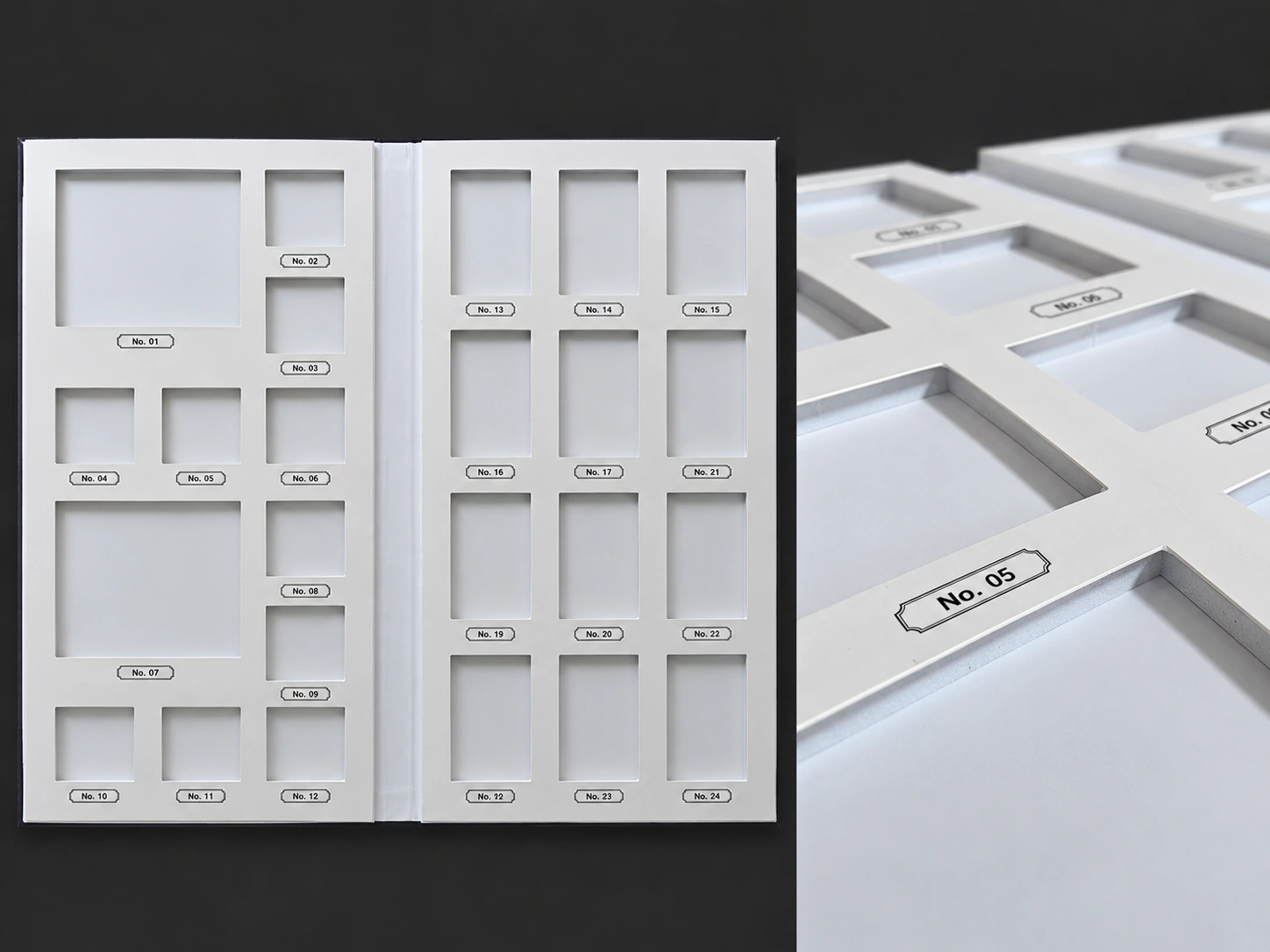
Either way, clients usually receive the books empty and fit the samples themselves. We build the pages and openings to the sample size and thickness you give us. Accurate sizes mean the samples go in smoothly.
What Size Should Carpet Samples Be, and How Many Per Book?
We don’t decide that for you. That’s not us dodging the question. There honestly isn’t one right answer.
Every country, and every company, has its own idea of how big a sample should be. Some brands go small and complete. Dutch carpet brand DESSO, for example, cut its samples to a uniform 10 × 10 cm (about 4 × 4 in) to reduce waste and save space on designers’ shelves. Other clients want people to feel a large piece and see the full pattern and pile. Both are right. It depends on who your clients are and how they look at samples.
 barbourproductsearch.info
So we work the other way round. You set the sizes the way you like, send us the numbers, and we check whether it can be made and whether it’s easy to carry. Here’s what we need:
- Length, width and thickness of each sample (measure the thickness with the pile relaxed, not pressed down)
- How many samples go in each book
- Roughly how heavy the samples are, or what kind of carpet they are (carpet tiles, broadloom, wool, long pile and so on)
- How it will be used: kept in a showroom, or carried by sales reps to clients
Once we see the numbers, we’ll tell you which format fits. If there are too many samples or they’re too heavy for a box, for instance, we’ll suggest a fold-out or a binder instead. For other formats, see our swatch book and custom sample book options.
What Else Should You Sort Out Before Ordering Carpet Sample Books?
Print the specs on the page, not just on a label. An article on carpet industry waste points to one problem: labels fall off loose samples, and then nobody can tell which product they are. With a book, the style code and color name can be printed right next to each sample, and collection details like pile composition and pile weight go on the cover or an inside page, just like the Saudi book. However the samples get handled, the information stays put.
 metropolismag.com
Will long-pile carpet get crushed? Generally, no. As long as the sample thickness you give us is accurate, we build in room for it when the book is closed. The spine is made a bit wider, so there’s space for the pile between the two facing pages. Besides, a closed book presses very lightly. Even if the pile flattens slightly, it won’t leave a mark. If you’d still rather be safe, go with the two-layer slotted pages described above. The samples sit inside the openings, and the problem goes away.
Cut and finish the samples yourself. How to cut carpet, and whether to bind or serge the edges, varies from maker to maker, and you know it better than we do. We make the books and boards that hold the samples. We don’t cut carpet for clients. Measure your cut samples accurately, send us the sizes, and fit the samples yourself when the books arrive.
Too heavy? Cut back instead of making the book bigger. Carpet samples add up. Rather than one big, heavy book, show fewer samples or cut them a little smaller. If you really do have a lot of heavy samples, switch to a binder with greyboard-core pages, which can take the weight. Your reps visit several clients a day, and a lighter book is the one that actually leaves the office.
Can Other Flooring Samples Be Done the Same Way?
Yes. Wood, laminate, SPC flooring, tile and stone all work the same way. The difference is that hard samples can’t just be squeezed in, so the openings have to be more precise and the weight needs more careful planning. For choosing between a box, a fold-out and a binder for hard flooring, see our guide to flooring sample boards. For how we handle other materials, see Materials & Applications.
If you’re planning carpet sample boards or carpet sample books, tell us the sample size, thickness, how many go in each book and how they’ll be used. We’ll check whether it can be made and how easy it is to carry, then send our suggestions and a design. Many standard constructions start from 5 pieces, depending on the samples, so you can make a few for your sales team to try first. To see how a project goes from design to production, see sample book design and manufacturing.