
When clients with thick samples receive their empty fold-outs from us, the first thing they usually ask is: “What do we use to stick these on?”
The answer is simple: hot glue. The heavier or smoother the sample, the more glue you use. There’s also a bonus many people don’t know about. When you need to swap a sample later, warm the glue with a hair dryer and the sample comes off.
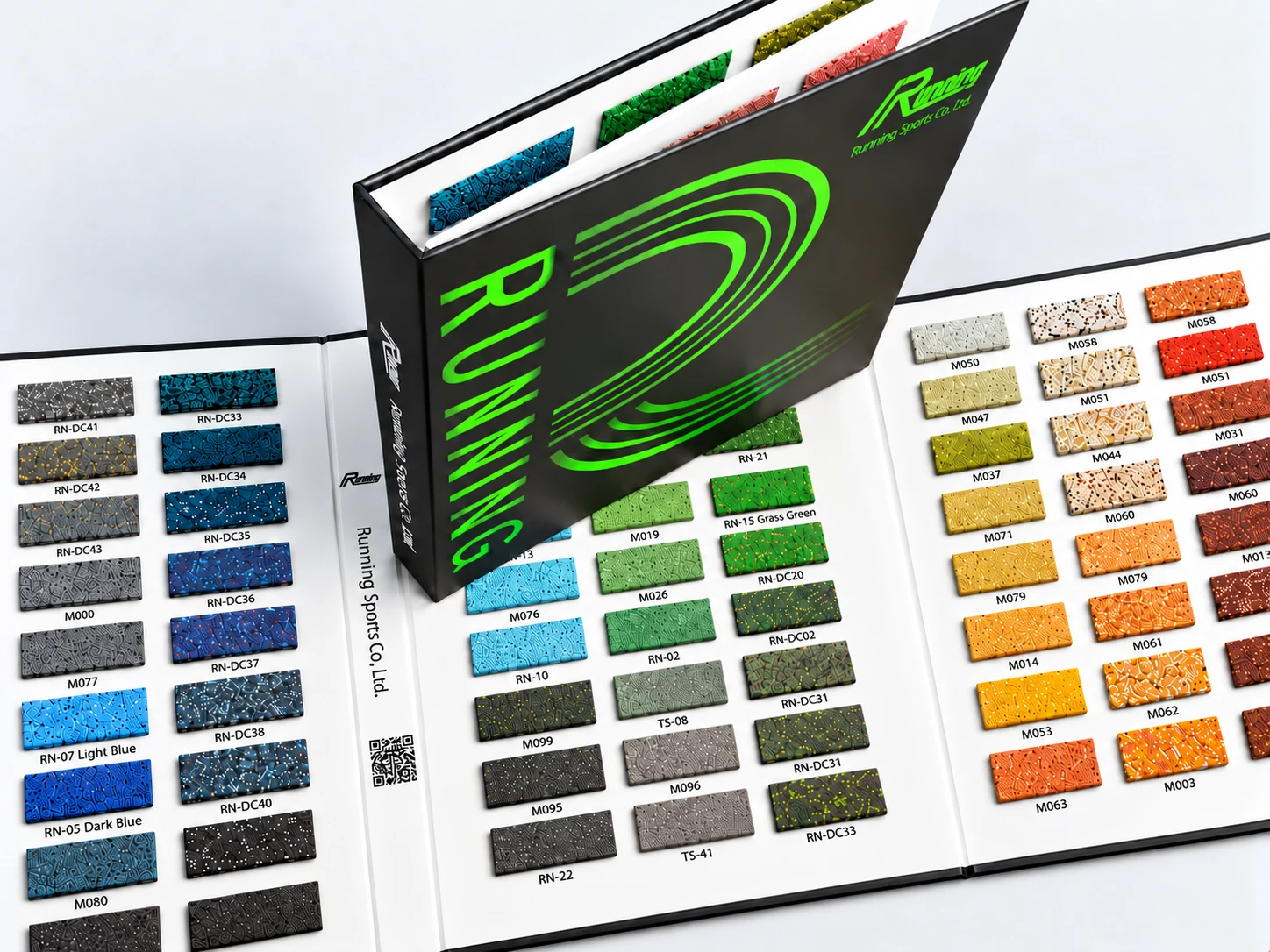
This article is about brick sample boards, also called architectural sample boards: how to turn thick, heavy building materials like brick and stone into boards you can take to trade shows and client meetings. It isn’t only about brick. We’ve made boards for stone, running track material and aluminum panels, and the method is the same. To us, these are different names for the same job. Whether it can be done comes down to one thing: can the samples be cut thin or small?
Which Building Materials Can Go on a Sample Board?
If the samples can be cut thin or small, we can make it. The material matters less than the shape, size, thickness and weight. For example:
- Brick and brick slips, cultured stone, cladding panels
- Pavers and landscape stone
- Roof tiles and asphalt shingles (roofing and shingle sample boards)
- Running track material, and rubber flooring for playgrounds and gyms
- Artificial grass
- Aluminum panels, composite panels, metal cladding
- Composite decking
Marble, granite and tile are covered in our guide to tile sample boards, which explains how to choose between a box, a fold-out and a binder by weight and quantity. This article focuses on samples that are thick. For how we handle other building materials, see Materials & Applications.
Why Use a Flat-Mounted Fold-Out for Thick Samples?
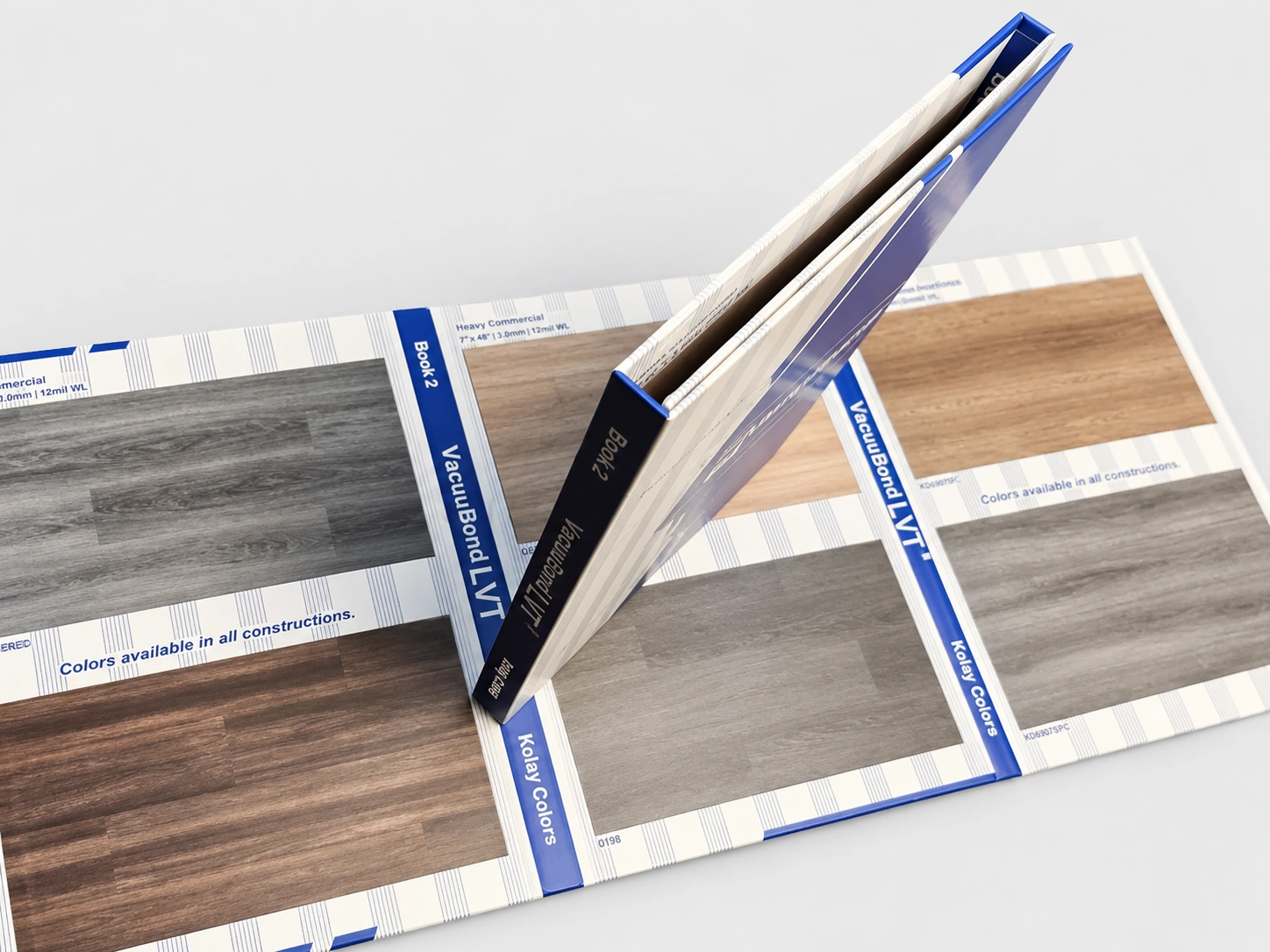
When samples are thick, we usually make a flat-mounted fold-out board: the samples are glued straight onto the page, with no slots. A slotted page has to be at least as thick as the sample. With thick samples, the slots get so deep that the process may not be able to handle them, the whole book ends up thick, heavy and awkward to carry, and it costs more. With flat mounting, the page only has to hold the sample up.
The fold-out is built on greyboard:
- 2.5 mm (about 0.1 in) greyboard for most jobs. It won’t warp, even with thick samples mounted on it.
- 3 mm (about 1/8 in) for extra-thick or extra-heavy samples.
- Anything thicker doesn’t work. For a fold-out to fold, the fold lines have to be grooved first. If the greyboard is too thick, it’s hard to groove and won’t fold.
So when samples are heavy, the first step is to make them lighter (more on thin slices below), not to keep adding board thickness. If you have more samples than one fold-out can hold, switch to a sample binder with greyboard-core pages.
What Glue Works for Thick, Heavy Building Samples?
Hot glue. A hot glue gun and some glue sticks from a hardware store or online are all you need.
The amount of glue has to match the sample, and we learned that the hard way. We once mounted some very thick marble samples. We use hot glue on our covers all the time and know how strong it is, so we ran our usual bead of glue around the back of each sample. Everything looked fine at first, but a little while later the samples started falling off. We added more glue, and they held. We haven’t had a problem since.
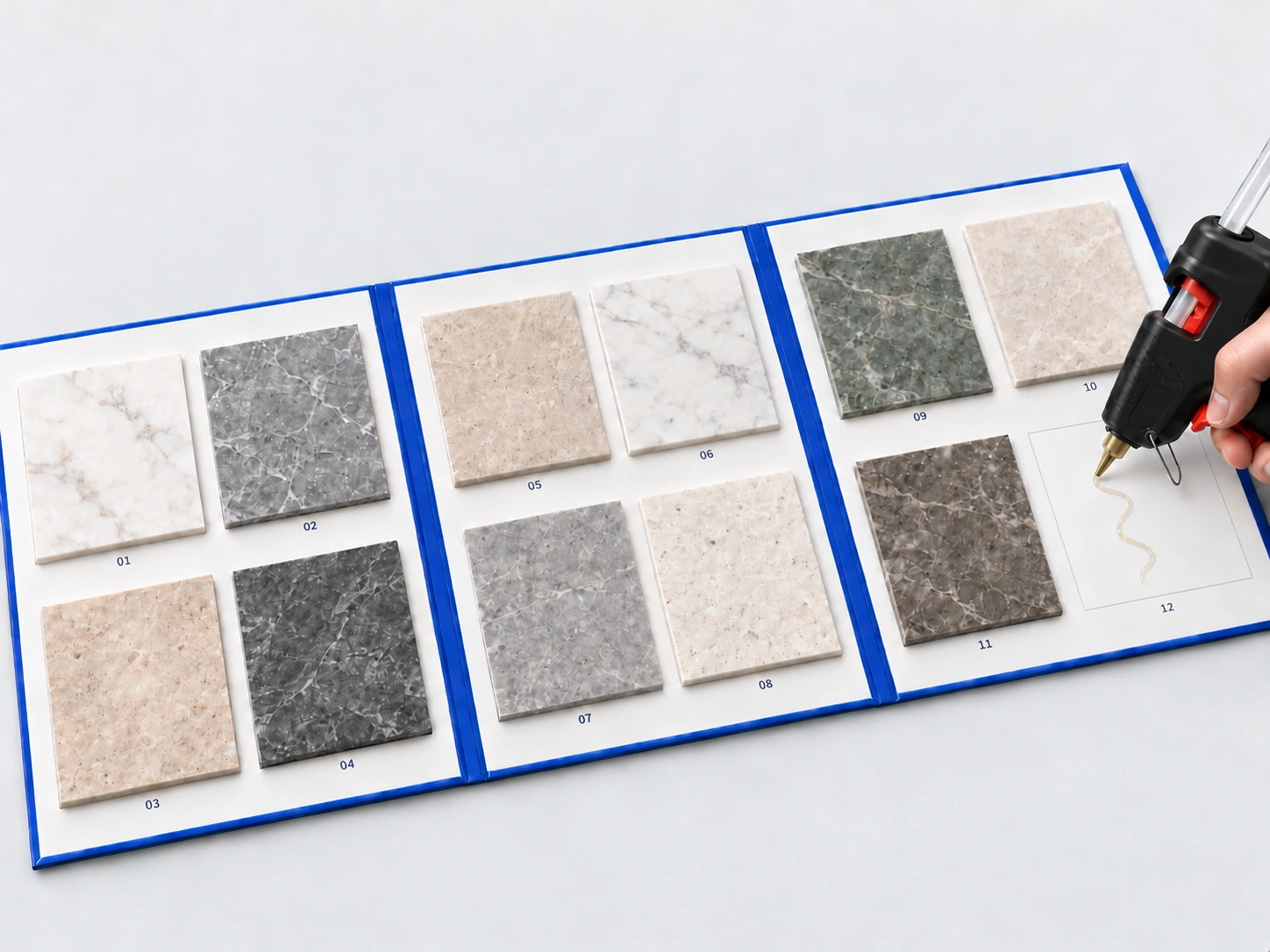
Don’t be sparing with the glue. If a sample has some weight to it, or its back is smooth (aluminum panels or polished stone, for example), use more hot glue. Extra glue won’t show, since it’s on the back of the sample.
For thick, heavy samples, hot glue holds more securely than double-sided tape. Tape is better for thin, light samples such as carpet and fabric.
Can You Swap a Sample After It’s Glued?
Yes, and that’s the other advantage of hot glue.
When a product is updated or a color is discontinued, you don’t have to throw out the whole fold-out. Blow hot air on the glue between the sample and the page. Once the glue softens, the sample lifts off. A little hot glue stays on the page, and there’s no need to scrape it off. Put the new sample in place, warm the glue again, and it holds the new sample. We swap samples this way ourselves, with a hair dryer.
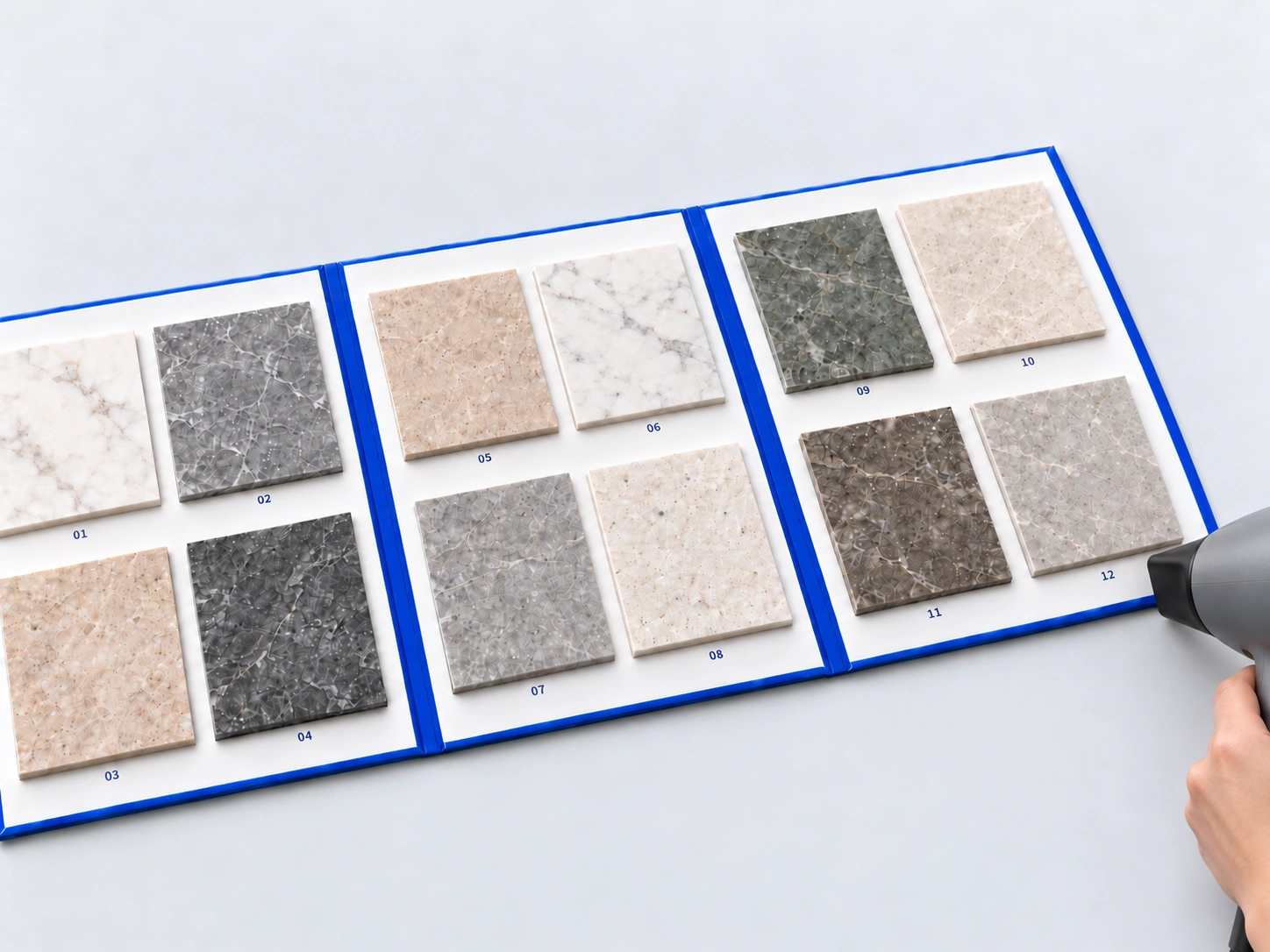
It works because hot glue softens again when it’s heated. Make magazine’s hot glue tips say the same: if you need to adjust something you’ve hot-glued, reheat the glue with a heat gun and reposition it.
Keep the heat moving and don’t hold it on one spot for long. The paper or cloth on the cover can overheat, and it will wrinkle and spoil the look.
Brick Is Heavy. Should You Cut It into Thin Slices?
If you can, yes. If you can’t, we can still make the board, but think about what it’s for: trade shows and client meetings. If it’s too heavy, your sales reps get tired carrying it, and clients find it awkward to hold and flip through.
Brick makers do it this way themselves. A technical bulletin from Canada Brick notes that a brick sample board usually doesn’t use whole bricks, only slices of the brick face about 1/2 in (about 1.3 cm) thick, with 6 to 15 pieces per board. Brick slip samples sold by UK building suppliers are also laid out in four rows on a cardboard panel.

Whether to slice, and how thin, is your call. Tell us the sample size, thickness, weight and how many go in each book, and we’ll check whether it can be made and whether it’s easy to carry.
One more note for brick makers: the same bulletin points out that a sample board is for choosing color and texture. It can’t show how a finished wall will look. For that, clients still need a mock-up panel built on site.
If you’re planning brick sample boards or other thick building material samples, tell us the sample size, thickness, weight, how many go in each book and how they’ll be used. We’ll check whether it can be made, then send our suggestions and a design. Many standard constructions start from 5 pieces, depending on the samples. For other formats, see our sample board and swatch book pages. To see how a project goes from design to production, see sample book design and manufacturing.