
For most office, hospitality, retail, and client-facing teams, magnetic name badges are a practical starting point because they avoid pinholes and are quick to reposition. Pin backings may suit thick garments, high-movement work, tighter budgets, or wearers who need to avoid magnets near implanted medical devices. Choose only after checking uniform fabric, daily movement, loss risk, budget, and workplace safety requirements.
How do magnetic and pin name badge backings work?
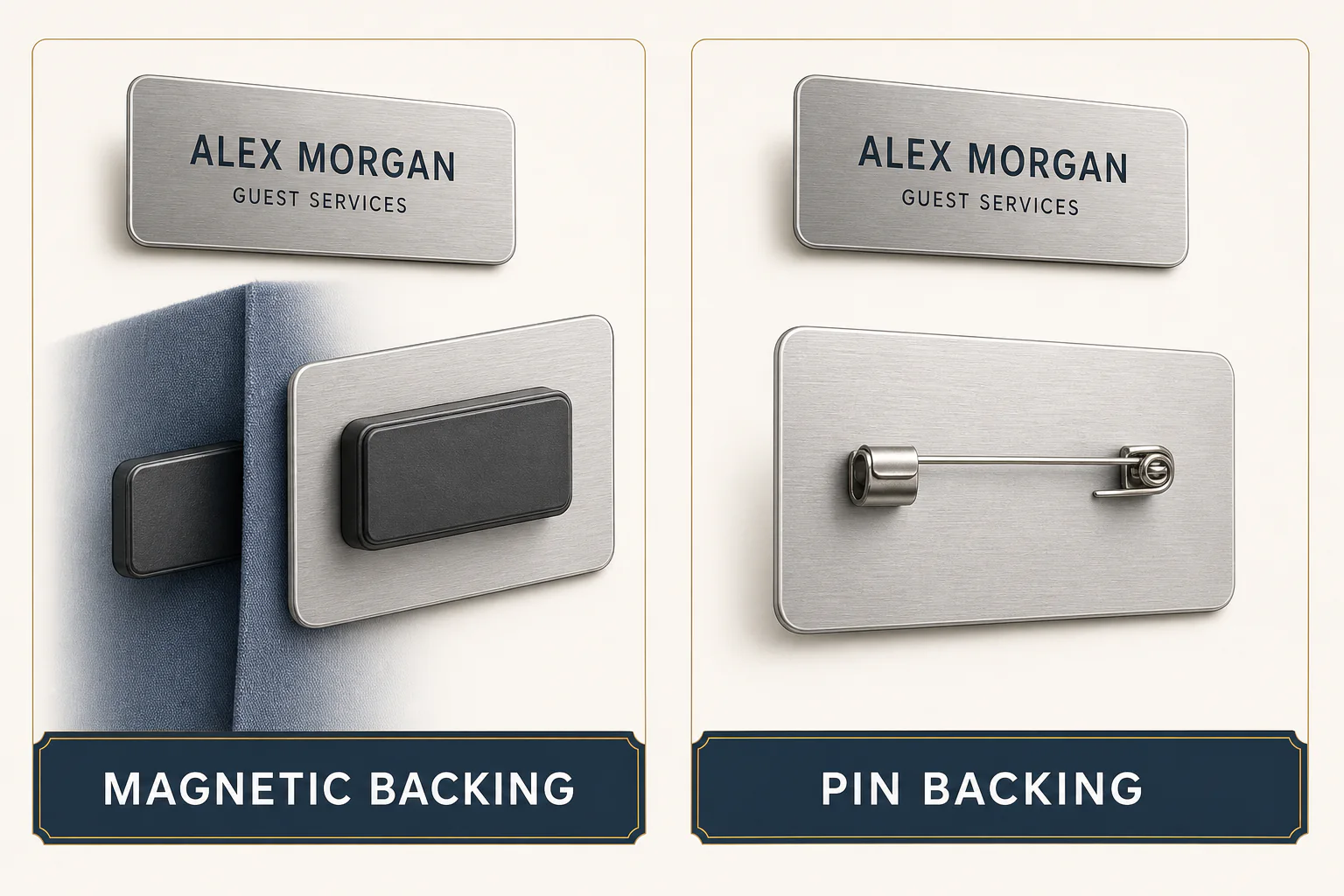
Magnetic backings hold the badge through the garment with a paired magnetic fitting, while pin backings pass a pin through the fabric and close behind it.
This choice concerns the back, not the badge face. Choose a permanent metal, reusable insert, or domed resin badge first. With a magnetic fitting, one part stays on the badge and the other sits inside the garment. A pin passes through the garment and fastens behind it. Badge construction and garment layers affect either fit.
When are magnetic name badges a better fit?
Magnetic backings are often the first route to review for client-facing uniforms when avoiding pinholes and repositioning the badge matter.
They can suit office shirts, reception uniforms, retail clothing, and hospitality garments where fabric presentation matters. No pin passes through the garment, and the separate back piece makes the badge easy to reposition.
A thick jacket or layered apron can change how the fitting holds. Staff also need somewhere to keep the removable back piece. Before making magnets the default, ask whether any wearer or work area restricts magnetic items.
When are pin backings a better fit?
Pin backings may be a better route when the garment can accept a pin, daily movement is high, budgets are tighter, or magnets must be avoided.
A pin can suit thicker aprons, jackets, or workwear where one repeatable attachment point is acceptable. It also provides a non-magnetic option where magnets are restricted.
Pins pass through the fabric and may leave a small hole, especially after repeated use in the same area. Staff also need to fasten them carefully. A pin is not automatically more secure or suitable for every thick garment, and its price depends on the project.
How should uniform fabric and daily movement affect the choice?
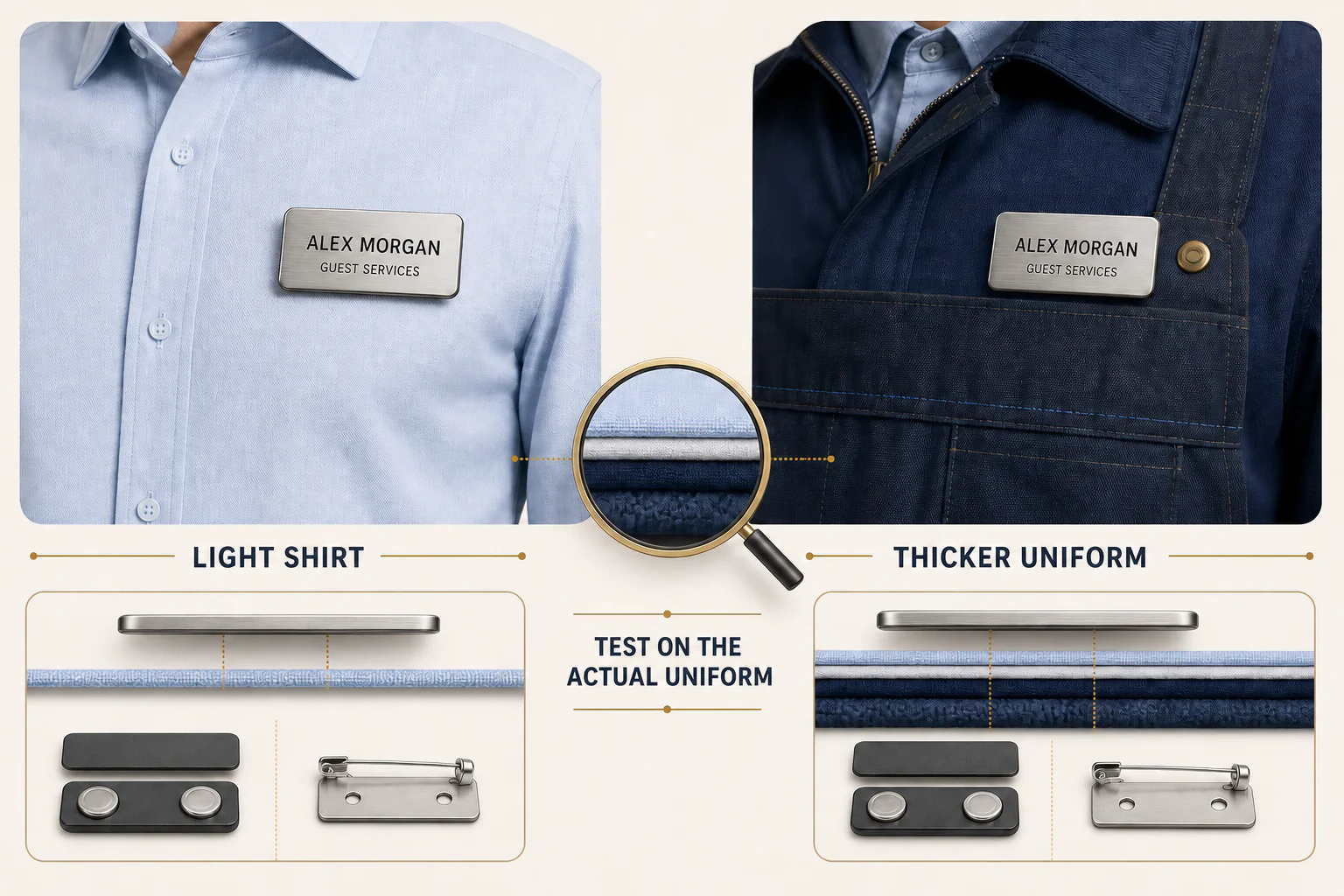
Review the real uniform first because fabric thickness, drape, layering, and daily movement can change how either backing feels and holds.
A light front-desk shirt and a lined work jacket are very different test cases. On a thin shirt, the main concern may be avoiding a puncture and keeping the badge level. A thicker apron or jacket adds material while staff bend, reach, or carry items.
Consider the full wearing routine:
- What fabric and layers sit between the badge and the backing?
- Is the badge worn for a full shift or only for an event?
- Does the role involve bending, lifting, or contact with equipment?
- How is the uniform washed and stored?
- Who keeps the badge and separate back piece after each shift?
If the team is unsure, send a clear uniform photo and describe the layers and daily tasks. Seeing a delicate or unusual garment is more useful than relying on a broad fabric label.
What safety restrictions should teams check before choosing magnets?
Teams should identify wearers who must avoid magnets and follow the device maker, healthcare provider, and workplace policy before assigning magnetic badges.
The U.S. Food and Drug Administration notes that sufficiently strong magnets can affect some implanted medical devices. Its page covers consumer electronics, not tests of name badge fittings. This guide cannot determine an individual wearer’s risk or set a safe distance for a badge.
Ask staff to flag relevant restrictions privately through the appropriate company process. If a wearer has been told to avoid magnets, request a pin, clip, or another non-magnetic fitting. Workplaces with magnetic-sensitive equipment or controlled areas should follow their own safety policy as well.
Can one team use the same badge design with different backings?
Possibly, but ask during quote review. Mixed backings depend on the selected badge family, fitting compatibility, quantity, and order details.
Keep one visual design, then mark exceptions in a “Backing exception” column. Enter “non-magnetic fitting required” where needed, without adding medical details. ZIVFY can then check whether the badge family and order support the proposed mix.
Which backing should your team choose?
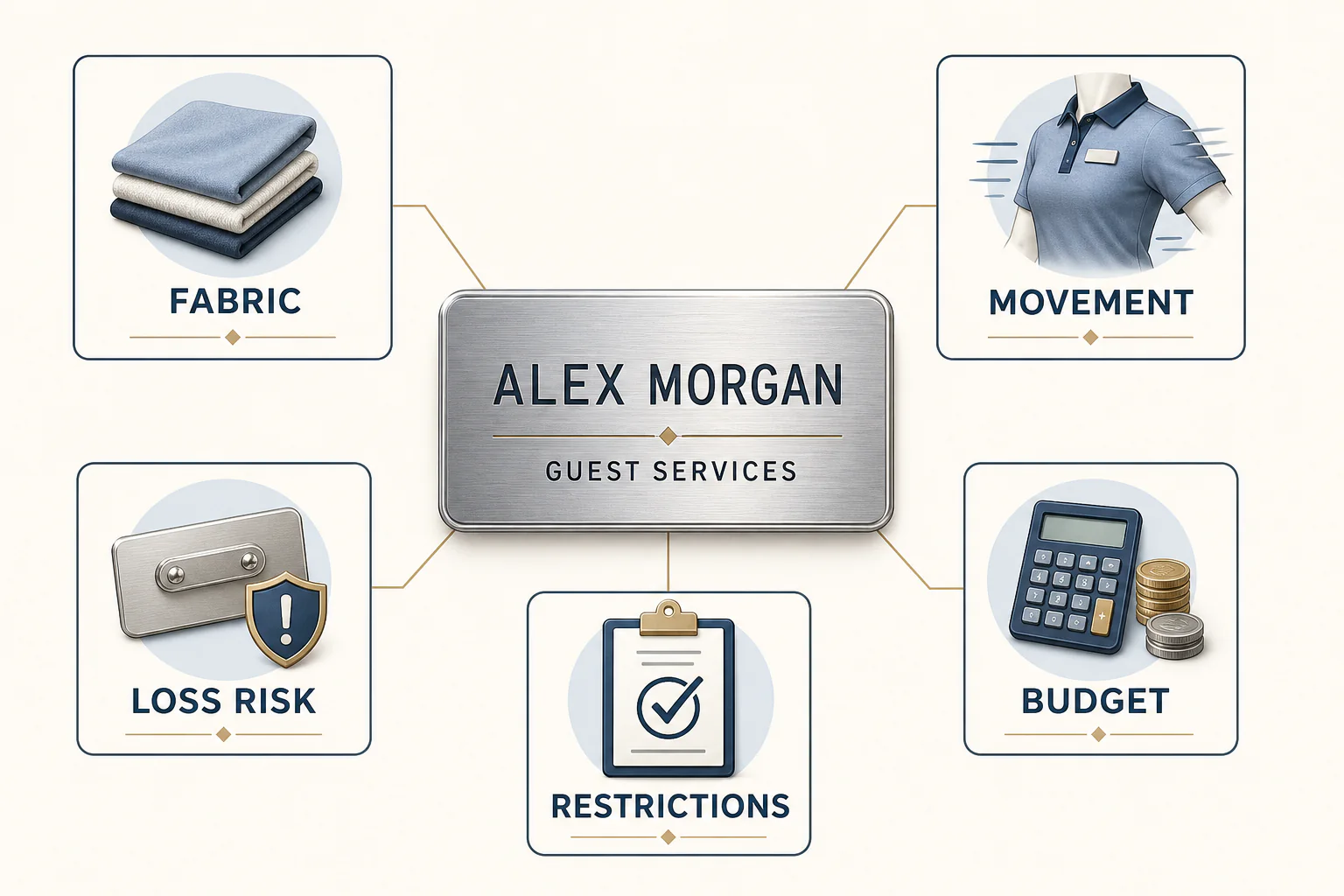
Start with the uniform and wearer restrictions. Then compare movement, clothing care, loss risk, and budget.
Magnetic vs pin name badges comparison
| Factor | Magnetic route | Pin route | Check before deciding |
|---|---|---|---|
| Garment contact | No pin passes through the fabric. | A pin passes through the garment. | Review the real uniform and any layers. |
| Daily use | Quick to remove or reposition. | May suit workwear that can accept a repeatable pin position. | Do not assume universal hold or security. |
| Wearer restrictions | Check implanted-device and workplace restrictions. | A possible alternative when magnets must be avoided. | Follow authoritative and individual guidance. |
| Clothing care | Avoids a pin puncture. | Can leave a small pinhole. | The effect varies by fabric and use. |
| Project planning | Confirm fitting compatibility and the risk of losing the separate back piece. | Confirm garment suitability and fastening preference. | Review the final route with the project details. |
Five questions usually expose the deciding issue:
- What is the uniform fabric, thickness, and number of layers?
- How much does the wearer move, and how likely is a separate back piece to be lost?
- Does the team want to avoid pinholes in presentation garments?
- What budget and replacement pattern apply to this team?
- Are there workplace rules or wearer restrictions that make a non-magnetic fitting necessary?
Once those answers are clear, compare custom name badge materials and backing options. Choose the family, set a default backing, and identify exceptions before requesting a quote.
Frequently asked questions about magnetic and pin name badge backings
Are magnetic name badges better than pin badges?
No. Magnetic backings often suit presentation uniforms because they avoid a pin puncture. Pins may suit workwear, tighter budgets, or magnet-restricted situations. Check the uniform, movement, restrictions, and project details.
Do magnetic name badges damage clothing?
They avoid a pin puncture, but garment wear also depends on fabric, badge weight, movement, and repeated use.
Which backing works with thick uniforms?
There is no universal thickness rule. Send a uniform photo and describe the layers so the proposed backing can be checked.
Can staff use different backings with the same badge design?
Sometimes. Mark wearer exceptions in the staff name list, then ask whether the chosen badge family and order support mixed fittings.
What if a wearer needs to avoid magnets?
Follow the device maker, healthcare provider, and workplace guidance. Request a non-magnetic fitting without adding medical information to the production list.
What project details should you send ZIVFY?
Send the badge family, backing, uniform type, wearer exceptions, logo, name list, quantity, country, and deadline.
Use a short project checklist:
- Badge family: permanent metal, reusable insert, or domed resin
- Provisional default backing: magnet, pin, clip, or not yet decided
- Uniform: fabric, thickness, layers, and a clear photo if possible
- Wearing conditions: shift length, movement, and work environment
- Exceptions: which roster entries need a different fitting, without medical details
- Artwork: logo file, required names, job titles, and departments
- Order: quantity, destination country, and required date
If the artwork or roster is not ready, use the logo and staff name list preparation guidance. If material or finish is still uncertain, you can also review material and finish samples, but sample availability depends on the project and may not include the exact badge and backing combination.
These details let ZIVFY assess the badge family, default backing, and staff exceptions together.