
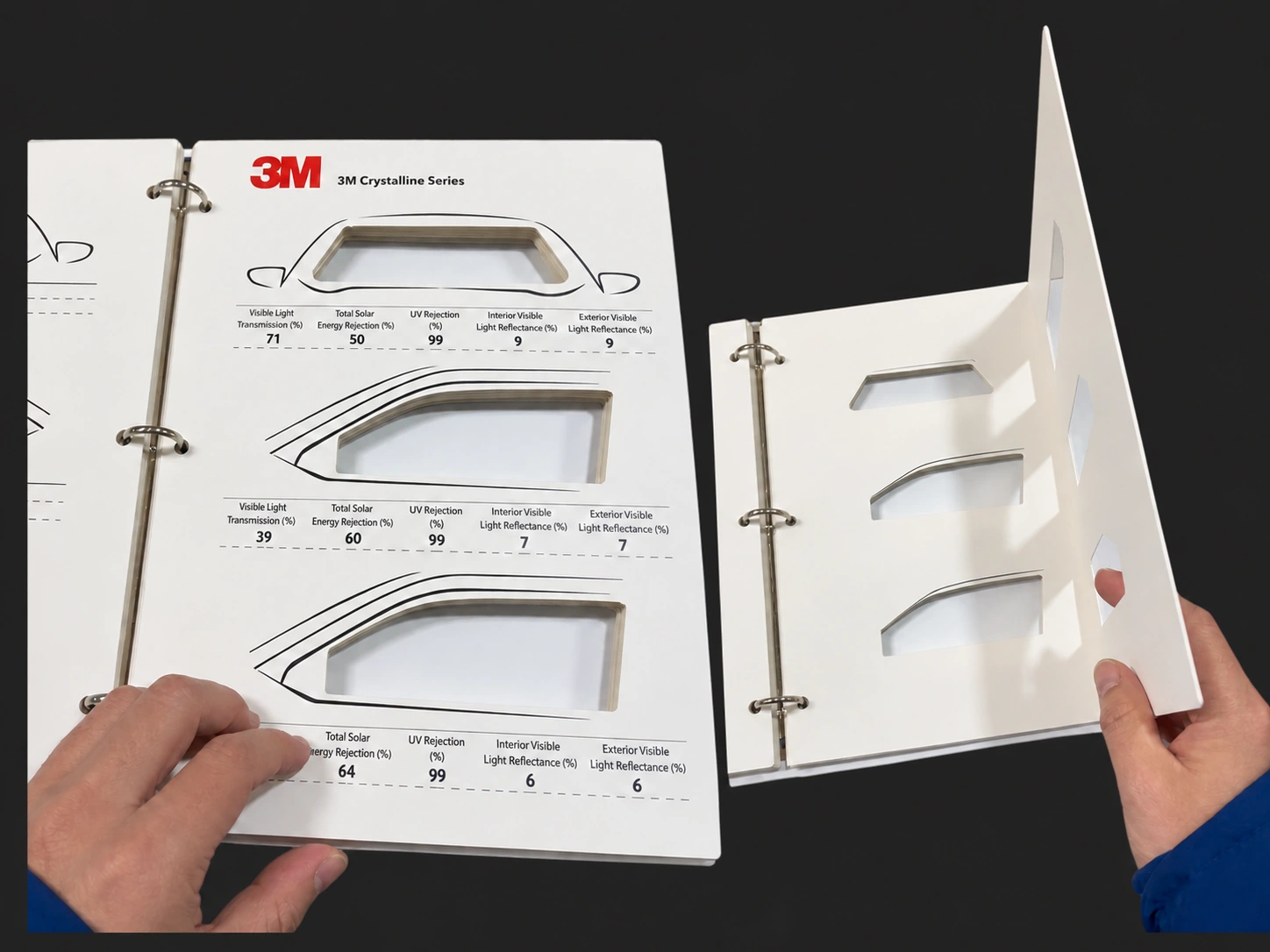
A window film sample book has two jobs: show the color, and show the VLT. In the books we make, each film sits between two layers of paper with a window cut through them. Your customer turns to a film, holds the page up to the sun and sees exactly how dark it is. Behind the window, the paper stays solid and carries the specs, which they read through the film.
The format depends on your range. A large range, or one that keeps growing, goes in a ring binder. A handful of films fits a fold-out. If you want a book that feels good to page through, bind it. The same approach works for a car window tint sample book, a vinyl wrap swatch book or a PPF sample book.
What should a window film sample book show?
Not thickness. Each type of film already comes in standard thicknesses, and the people buying it know them. What they compare in a sample book is color and VLT: how much darker 20% looks than 35%, and which film leans blue and which leans gray.
VLT stands for visible light transmission, the share of visible light that passes through the film. The lower the number, the darker the film. The International Window Film Association explains how this and other performance figures are rated.
 iwfa.com
So the page has to be built around one thing: getting light through the film. Mount a swatch flat on white card and no light comes through it, and the VLT becomes a number printed beside it.
Why put the film between two layers with a window?
Each page is one large sheet folded in half, with matching windows cut through both layers in the same position. The film is cut a little larger than the window and fixed between the layers. When the page is closed, all four edges are held in and the film shows from both sides.
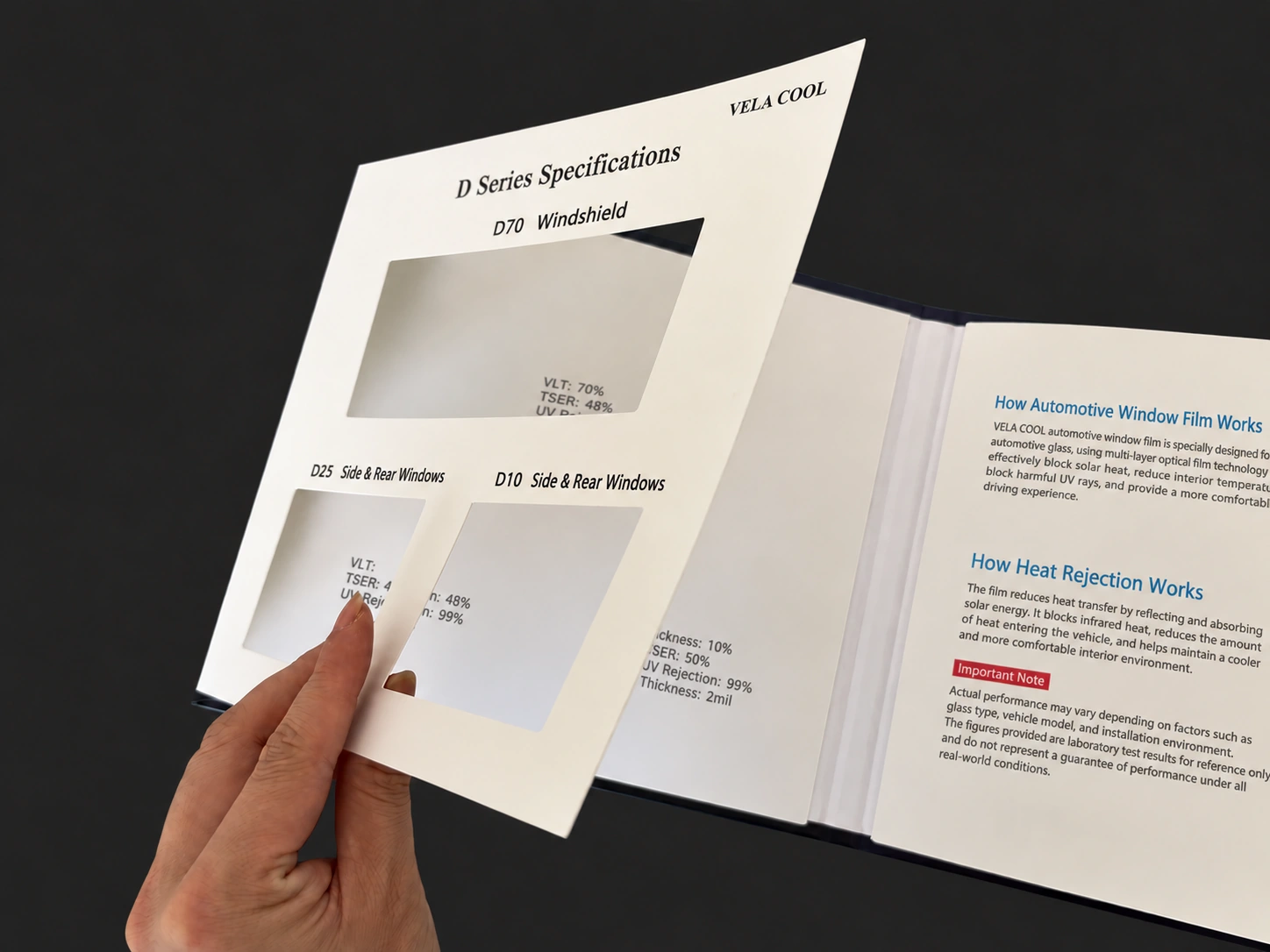
You can also cut the window on one side only. The other side stays solid, and the specs for that film are printed right where the window sits: VLT, heat rejection, UV rejection and thickness. Since the film lets light through, people read the specs through it, and while they read, they see how dark the film is. The same black text is crisp behind a 70% film and much dimmer behind a 5% one.
Do vinyl wrap and PPF swatches need a window too?
Yes, and for them a slot between the two layers matters even more. The swatch slides into the slot, so your customer can pull it out, check the color and how it feels, and hold it up to the light to see whether any light gets through. A swatch stuck flat on the card can’t be handled that way.
Window film, vinyl wrap and PPF use the same page structure. What changes is the job of the opening: for window film it lets light through, and for wrap and PPF it lets the swatch come out.
A real example: a window film brand with a small range
VELA COOL, a Chinese window film brand that makes heat-rejecting, shatter-resistant film for cars, came to us looking for a good way to present their samples. Their range was small, and what they most wanted customers to see was VLT, so their team could use the book to explain what each film does.
We suggested a fold-out: the cover folds, and the inside pages fold too, opening out panel by panel like an accordion. A customer who wants to check a film’s VLT lifts that panel and holds it up to the sun. Each window is printed with the film’s code, whether it’s meant for the windshield or the side and rear windows, and its VLT and other specs.
They went with it for two reasons. It’s easy to carry and hand over, and it does what they needed. Their samples aren’t there to show a piece of film. They’re there to show VLT.
Large or growing range: a ring binder
For A4 pages, we fold an A3 sheet in half, cut matching windows through both layers and punch the page for the binder; the film goes in between. When you launch a new film, you add a page instead of reprinting the whole book. When a film is discontinued, you take its page out.
Capacity isn’t a concern. Film and paper are both thin, so one binder holds a few hundred pages. With several films to a page, that’s well over a thousand films, more than any film brand sells. You can see the binder formats we make on our sample binder page.
Small range: a fold-out
This is the VELA COOL format. One card folds in half, or into several panels, with windows holding the film on one side and the specs printed on the other. Folded, it’s the size of one card, easy to keep in a bag or mail to a dealer.
Better feel: a bound book
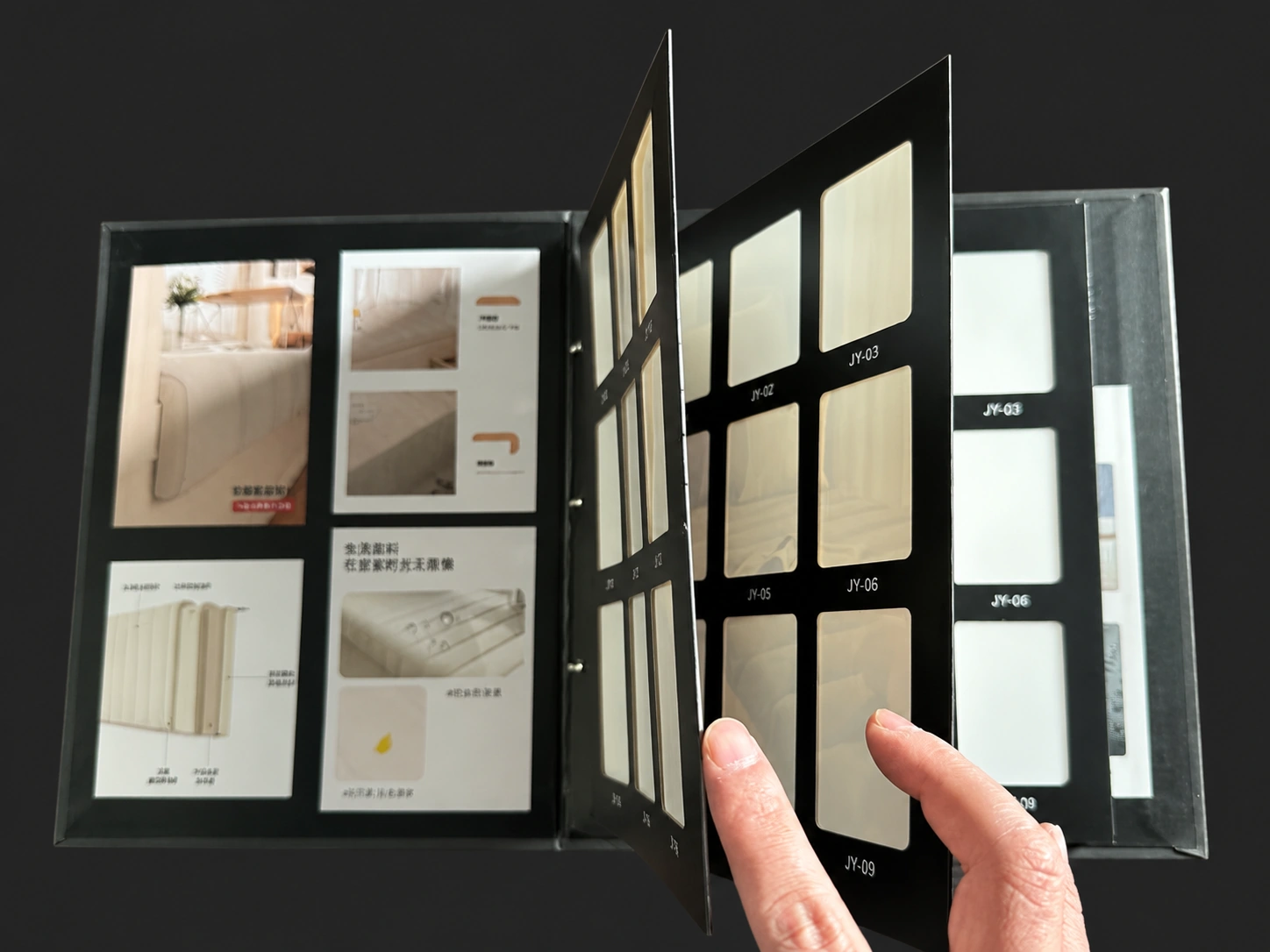
Each page has its film fixed in place, and the pages are bound into a book that’s turned page by page. It feels better in the hand. Once it’s bound, you can’t add a page, so it suits a range that’s settled and won’t get new films soon.
How big should the book be, and how many films per page?
You choose the size. Tell us how many films you have and how big you want the book, and we work out how many windows fit on a page and how large each one can be. We do the same for every custom swatch book we make.
With 8 films, for example, a fold-out with 4 on each side already gives every window plenty of room to see clearly against the light. Cut each film 1 cm (about 3/8 in) larger than the window on every side, and use double-sided tape on that border to fix it to the paper. It sticks easily and stays put.
Who cuts and fixes the film?
For a few copies, a dozen, or a few dozen, we suggest you cut and fix the film yourselves. Film is easy to cut, and the cut doesn’t need to be exact. A slightly crooked edge doesn’t matter, because the film sits between two layers of paper and its edges are covered once the page is closed. We deliver the books empty, with the windows already cut.
For large quantities, we’ll talk it through with you, and we can do the cutting.
Which films don’t suit this format?
A film too thick to lie flat between two layers of paper won’t work with windows. When that happens, we’ll put together a different option for you to look at, and you go ahead only if it suits you.
What should you send us for a quote?
- How many films you have, whether they’re window film, vinyl wrap or PPF, and whether you’ll add more later
- The book size you want
- Which specs to print for each film
- How many books you need
Send us these and we’ll come back with suggestions and a layout. Request a quote or read more about our sample book printing.