
A new fabric season is out, and a few colors in last year's sample book are discontinued. That book is still on designers' shelves and in your sales reps' bags, clients still order from it, and someone has to call them one by one to say the color is gone. Remaking the whole book means new layouts, new printing and loading every sample again.
Whether a sample book can keep up with your collection isn't decided on the day you update it. It's decided the day you place the first order. Get three things right then, and each update means swapping a few pages. Get them wrong, and every update means starting over.
Plan for updates on your first order
First, make it a binder. Almost every client who comes back to add or replace pages uses a refillable sample binder. Fold-outs and bound books are fixed once they're made, and changing them means remaking the whole book. So if your collection changes every year, start with a binder. If your products stay the same for years, a fold-out or a page-turning swatch book makes more sense. Fabric brands are our largest group of clients, but a binder can hold samples of almost any material: tile and stone slices, small stainless steel and aluminum chips, wood veneer, high-pressure laminate (HPL), leather, carpet and wallpaper. Pages can be flat-mounted, slotted or take card inserts, and heavy samples go on pages with a greyboard core. If your products gain new colors and lose old ones, the same approach applies.
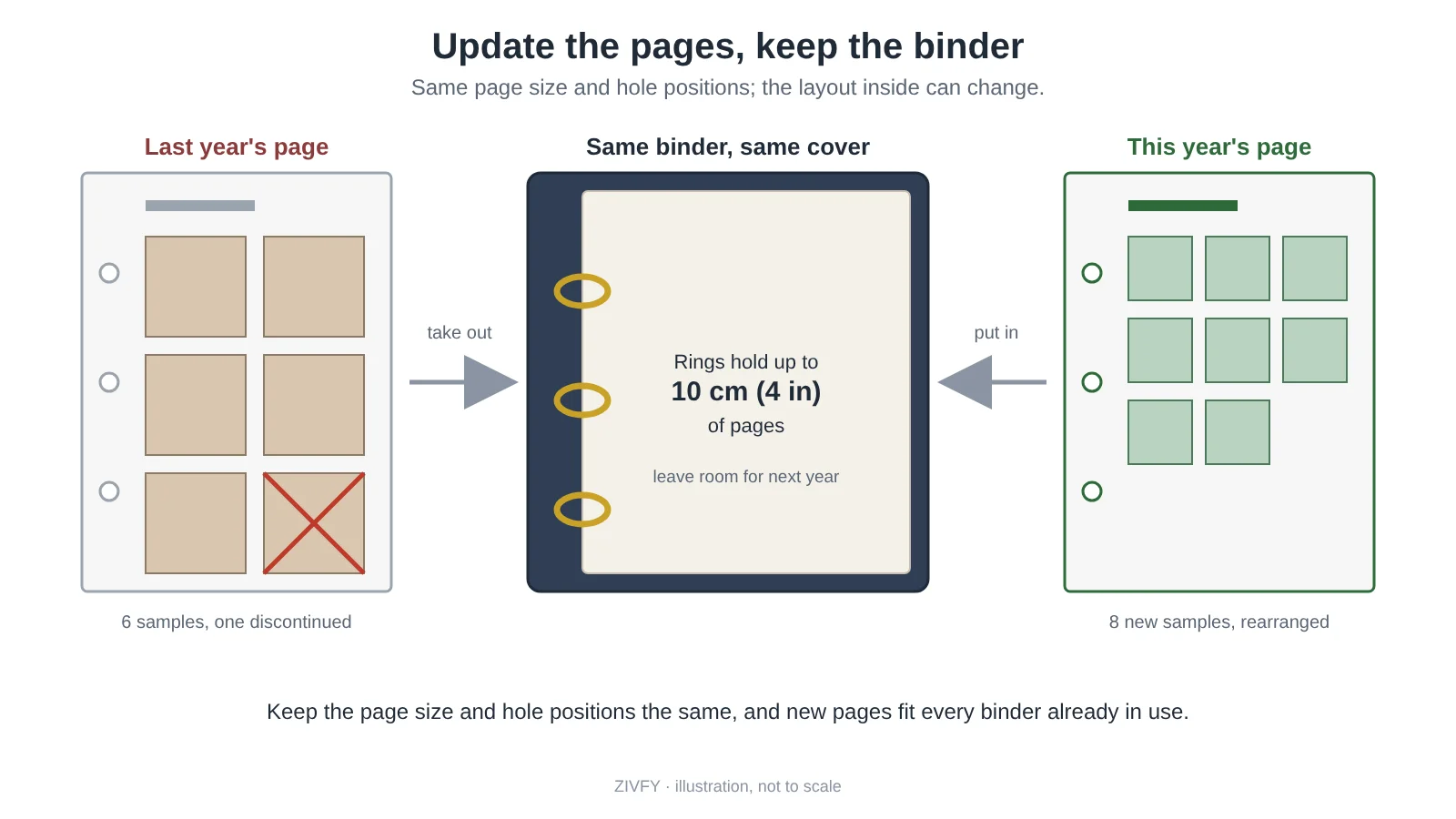
Second, fix the page size and hole positions. Whether a new page fits an old binder depends only on these two things. As long as they stay the same, everything inside the page can change. If the size changes, new pages won't fit the dozens of binders already out with designers and reps. One US plastic sheet brand ran into exactly this when it redesigned its swatch pages: the new pages didn't fit the binders customers already had, so they needed new binders as well (Rowmark).
 jpplus.com
Third, order a bigger binder. How much a binder holds depends on its rings. Our largest binder holds up to about 10 cm (4 in) of pages, which is a few hundred plain pages; pages with mounted or slotted samples are thicker, so fewer fit. On your first order we work out how many pages you have now and how thick they'll be, then suggest a binder with room to spare. A binder that isn't full closes without any problem. One that's too small leaves no space for next year's colors, let alone a new product line.
A year later, send us a list
Fabric brands usually update once a year. Some add a few pages of new colors; others replace every page and keep the covers and binders. A year on, few people remember the page size, where the holes were punched or which font they used, and they don't need to, because we keep all those files. Tell us which pages come out and which colors go in, and we update the original files and send you a drawing to approve. If the new samples are cut a little larger or smaller, or you want six or eight samples a page instead of the old layout, we rearrange them on a page of the same size. That's why page updates rarely cause problems. For how this works with curtain and roller blind collections, see our guide to curtain and upholstery fabric sample books.
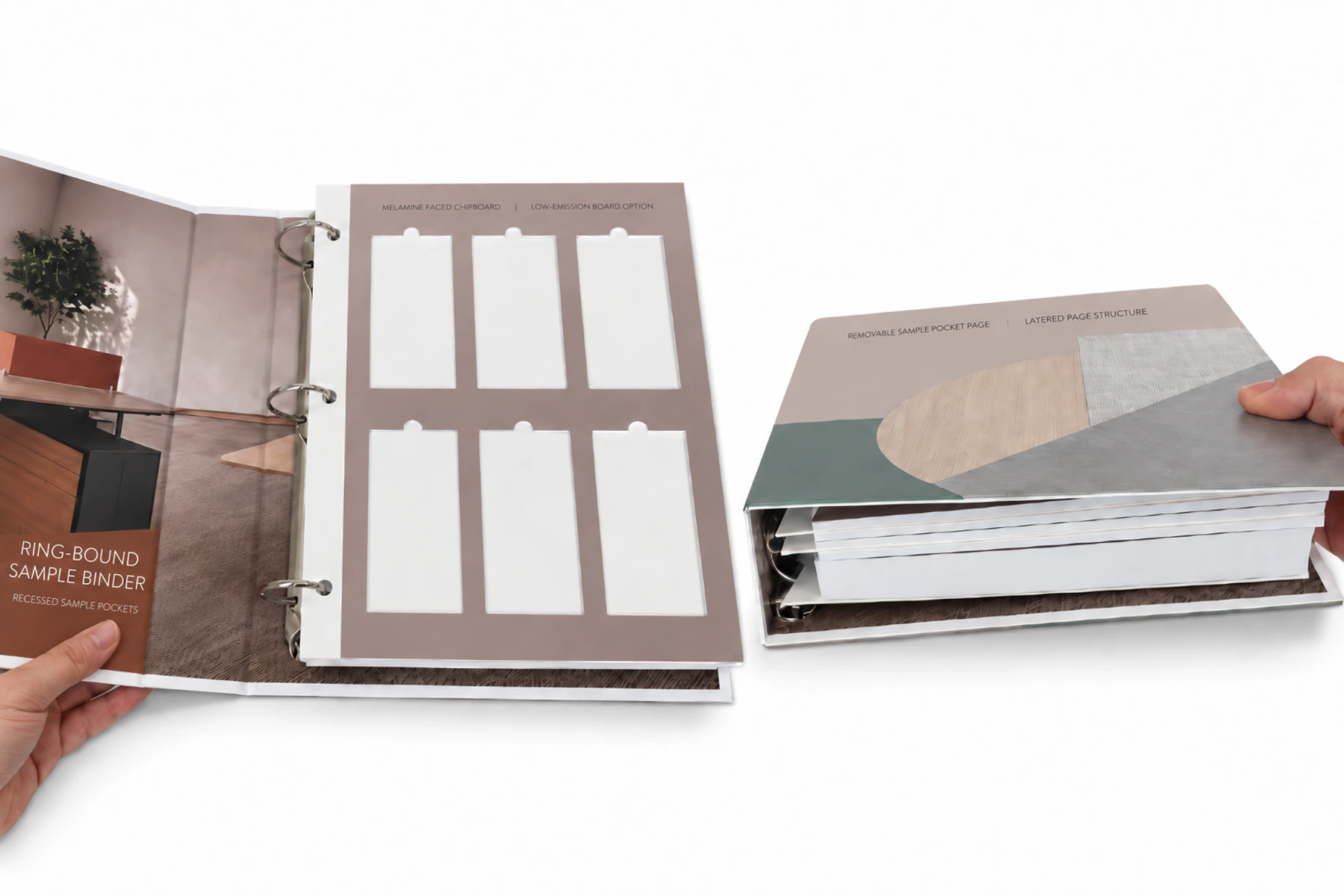
Almost every book we make carries lot and color-variation notes. With a binder, those notes travel with each page: when a color changes lot or code, only that page is reprinted.
Getting new pages to designers is straightforward too. Many interior design studios shelve sample books by manufacturer so brand reps can update them and pull discontinued items when they visit (SG23 Design). A rep brings the new pages, swaps them in on the spot, and the old binder stays on the shelf.
 sg23design.com
A fan deck doesn't need new pages at all
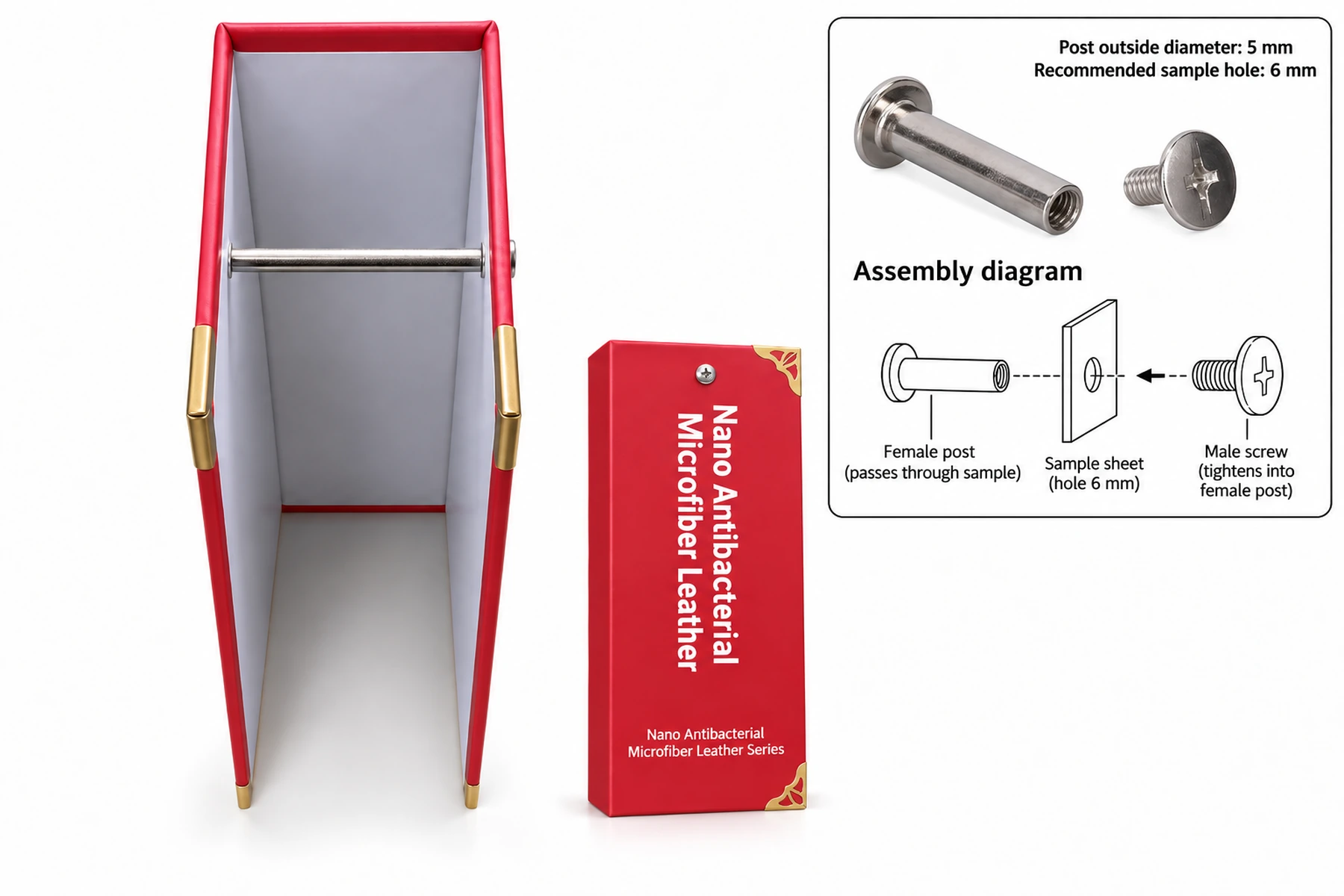
Fan decks are even easier to update. The chips are held together with Chicago screws: undo the screw, take out the discontinued chips and add the new ones. You can do it yourself without coming back to us. When the stack gets thicker, switch to a longer Chicago screw, which you can buy locally. If you know you'll add many chips later, ask for a wider spine or separate front and back covers from the start. See how they're made in custom fan deck.
Next step
On your first order, tell us how many pages you have now, how often your collection changes and roughly how much you'll add, and we'll set the page size and binder size with you. If you want to start with only a few copies, see small batch sample books. When it's time to update, send us a list of which pages come out and what goes in (contact us).