
A lot of new brands assume foil and embossed labels belong to big names with big print runs. It's the other way around: a small brand needs them more. On a shelf full of bottles, a raised logo under someone's thumb or a line of foil catching the light is one of the cheapest ways to look established. What keeps small brands away has never been the price of the labels themselves. It's the entry cost: plate fees and minimum order quantities.
At ZIVFY, short run foil labels start at 50 pieces, with no plate fees. Once that barrier is gone, only one thing is left that decides whether a small batch looks premium: the design.
Why short run labels with foil usually cost more
Foil stamping and embossing don't come off the press at the push of a button. Every design carries a fixed amount of preparation before production starts, and that work is about the same for 100 labels as for 5,000. So many label printers either charge a separate plate or setup fee, or set the minimum at 500 or even 1,000 labels to spread that cost. For a brand that only wants 100 bottles to test the market, that leaves two choices: pay more, or drop the foil.
Our custom foil labels start at 50 pieces with no plate fees, so you can run a small batch, put it on the shelf, and order more once it sells. Foil stamping, embossing, raised spot UV and sculptured foil embossing can all be combined on the same label.
With the cost barrier gone, the common mistake changes. It becomes "it's not expensive, let's just print it and see," and a design that hasn't been thought through goes straight to production.
The design decides the result, not the quantity
After years in print, what we see is that whether a label turns out well is rarely decided in production. Most of it is settled in the artwork. A well-designed label looks just as good at 50 pieces as at 5,000, and a poorly designed one looks wrong at any quantity. So when you send us your file, we go through the points below with you before we make the proof.
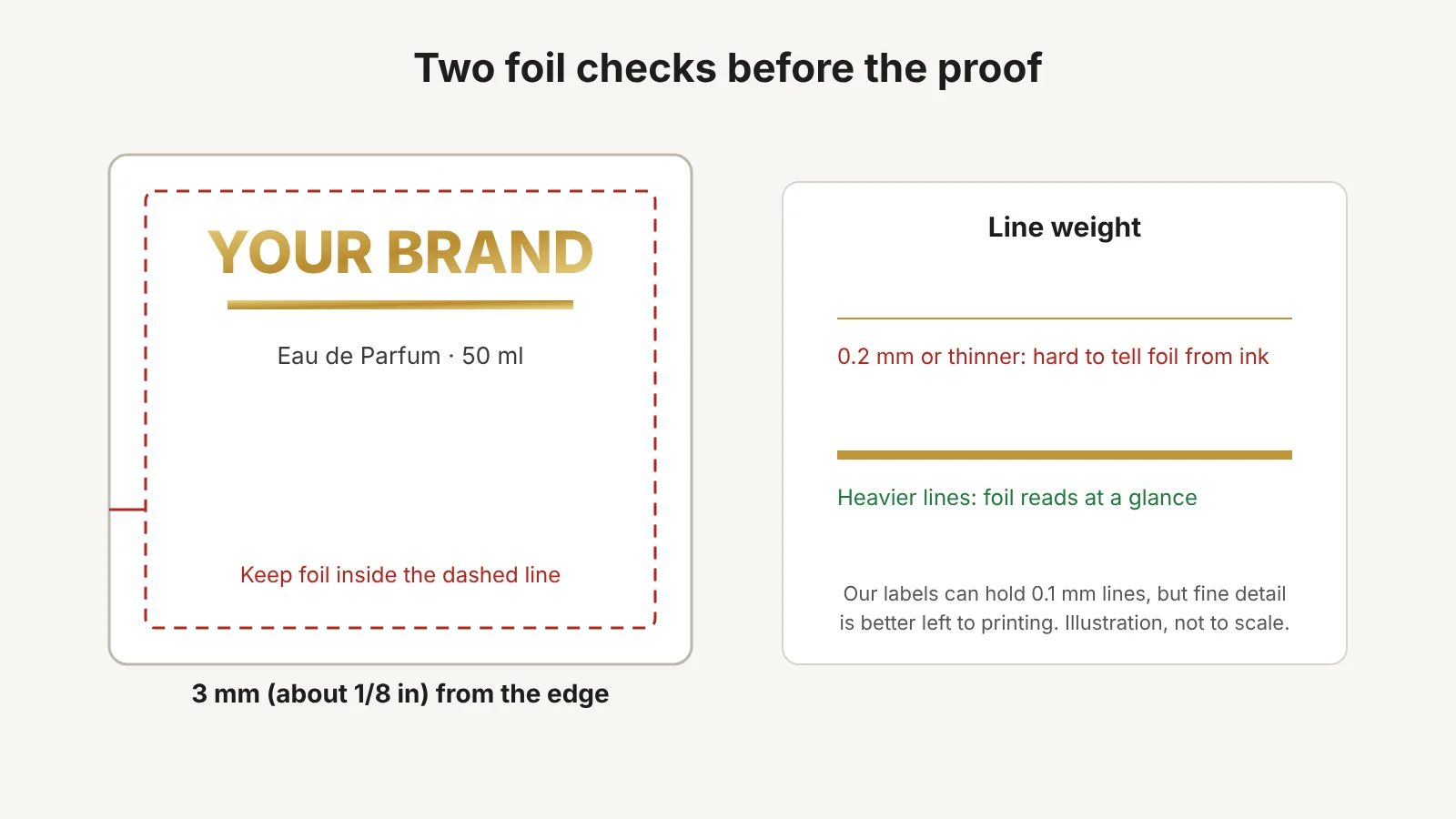
Lines can go down to 0.1 mm, but below 0.2 mm the finish disappears
Foil on our labels can hold lines as fine as 0.1 mm (about 0.004 in). Being able to print a line and it being worth printing are two different things, though. At 0.2 mm (about 0.008 in) or thinner, it's hard to tell foil from ordinary ink once the label is in your hand, and the money spent on foil is wasted. The usual culprits are small serif type, thin outlines and fine patterns. If you want people to see the foil at a glance, make the lines heavier than that, or save the foil for the logo and product name and leave the small text to the printing.
If you want to know how the foil itself goes on, see how foil stamping works. That article covers business cards, which use a different process with a different minimum line width.
Where foil or embossing meets printing, let it overlap slightly
This is the point we bring up most when we talk through a design. Many people worry about whether a foil area is too big or too small. Size isn't really the issue. What matters is whether the foil or embossing sits right against a printed design.
The reason is simple. Printing and foil or embossing aren't done in one pass. The label is printed first and then goes through a separate process, and there's always a tiny shift between the two. Printers call this registration: how precisely the foil lines up with the print. If the design has a foil border tight around a printed block, or an embossed logo set exactly inside a printed shape, even a slight shift shows up as a thin white gap or foil sitting on the print, and the eye picks that up immediately.
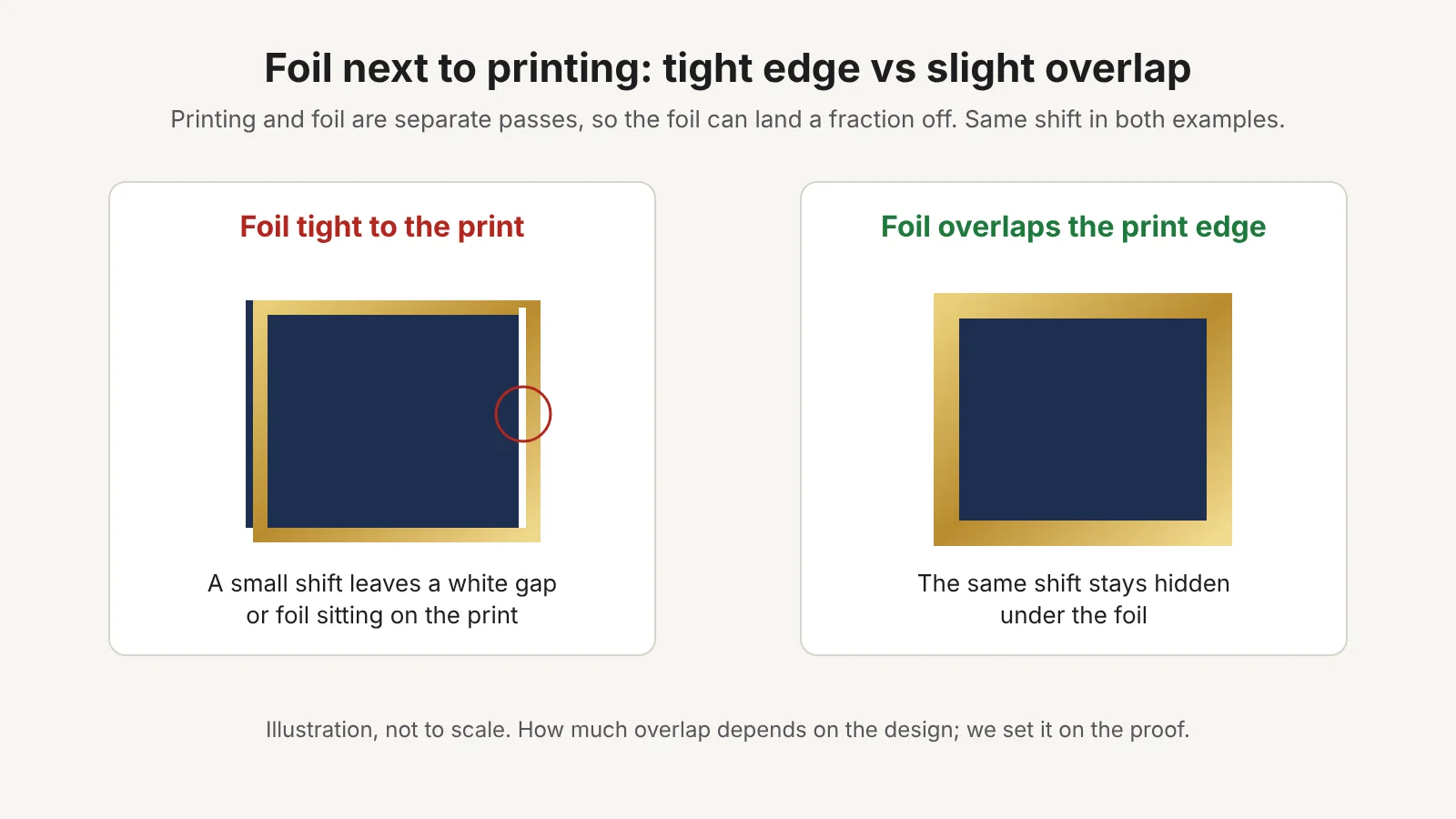
The fix belongs in the design stage. Let the foil or embossing overlap the edge of the printing slightly, so a small shift between the two passes doesn't leave a gap. There's no fixed amount; it depends on the artwork. We point it out when we see your file, adjust it, and show you the proof, and nothing goes into production until you approve it.
Keep foil at least 3 mm from the edge
Keep foil at least 3 mm (about 1/8 in) from the edge of the label. The reason is the same as above: die-cutting is another separate step, and foil placed right at the edge can end up with uneven margins or get cut through, which makes the whole label look crooked.
Embossing works on curved bottles too
Many people assume embossing only works on flat surfaces, not on round bottles or jars. In fact, embossing on our white PVC film labels works fine. The raised height depends on the design, and around 1 mm (about 0.04 in) is usually achievable. It holds up on the curved part of a bottle as well, so you don't need to switch to flat packaging just to get embossed labels.
Tell us where the label will be used, and we'll choose the material
Our premium labels come in two materials: white PVC film and coated paper. Before every order, we ask what product the label goes on and where it will be used, rather than leaving you to guess between two names.
| Material | Good for | Not suitable for |
|---|---|---|
| White PVC film (75 µm, about 3 mil, waterproof) | Bottles and jars that meet water or oil: craft beer in the fridge, spirits in an ice bucket, skincare, essential oils, olive oil | Containers that get hot, such as a burning candle jar |
| Coated paper | Dry uses: gift boxes, tea tins, seal stickers, hang tags | Anything that gets wet, collects condensation or is wiped often; containers that get hot |
Waterproof and water-resistant aren't the same thing. If you're not sure which you need, see waterproof vs water-resistant labels. If your bottle is clear and you want the contents to show through, that's a different product, covered in clear foil labels. Candle brands that can't use these labels can put metal stickers straight on the jar.
If color matters, white PVC film can take 7-color expanded gamut printing, which reaches brighter colors than standard four-color printing. See our page on RGB printing.
Sheets for hand-applying, rolls for machines
Many small-batch customers apply labels by hand, one at a time. For them we usually recommend sheets: A3 sheets, kiss-cut, so each label peels straight off. If you use a labeling machine, go with roll labels and tell us your core size (25, 40 or 75 mm, about 1, 1.5 or 3 in) and unwind direction. Without instructions, we default to outside winding, a 3 mm gap and a 75 mm core. The unwind direction chart is on the product page.
Which products suit short run foil labels
Small batches of foil and embossed labels work best for:
- Perfume and skincare labels: small bottles, high prices, and ranges with several products that each need only a few hundred labels.
- Gin, whiskey and craft beer labels from small producers: limited editions and seasonal releases are ideal for a small first run.
- Food gifts and jarred foods, such as honey jar labels for holiday gift sets and premium lines.
What they have in common is small volumes where the brand matters.
If the same products also need tags, our custom hang tags start at 50 pieces too, with foil on textured or kraft paper.
Send us your design and we'll review it first
At 50 pieces with no plate fees, cost is no longer what stands in the way; what's left is getting the design right. Send us your file, the size of your bottle or jar, the quantity and where the label will be used. For file preparation, see our artwork guidelines. We'll check line weight, registration and edge margins, tell you what needs changing, and then send a digital proof. If you'd like to see a physical sample first, we can make one; samples are charged, and shipping is extra.