
Painted edge vs color core business cards comes down to where the color lives. With color core, it’s built into the paper: three sheets are bonded into one card, and the middle sheet is a different color, so a colored line shows along the edge. With painted edges, the cards are printed and cut first, and then the whole edge is colored. Color core costs nothing extra for the edge. Painted edges cost more and come with a few risks. Before you decide whether business cards with colored edges are worth it, it helps to know what one looks like in your hand.
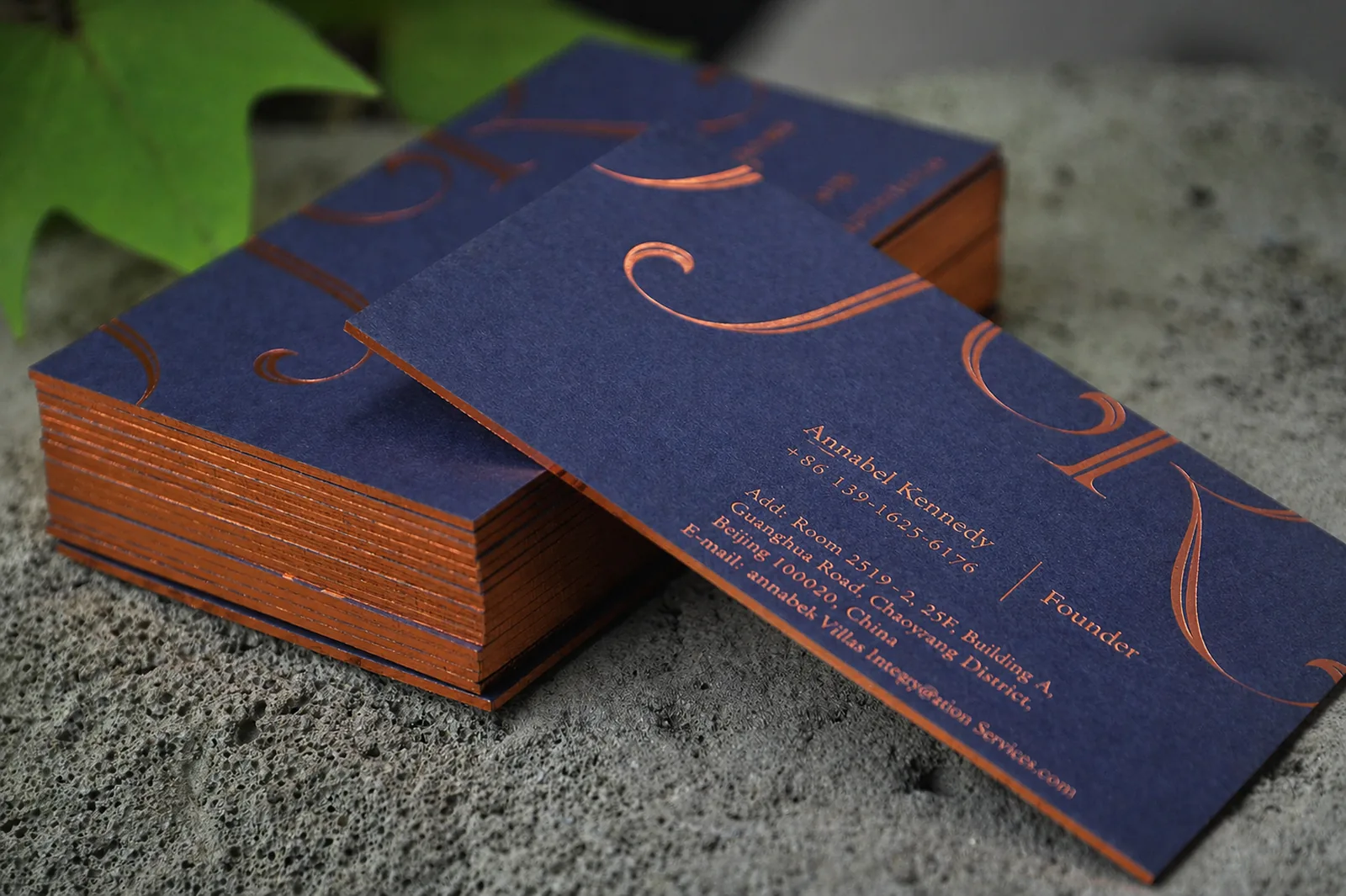
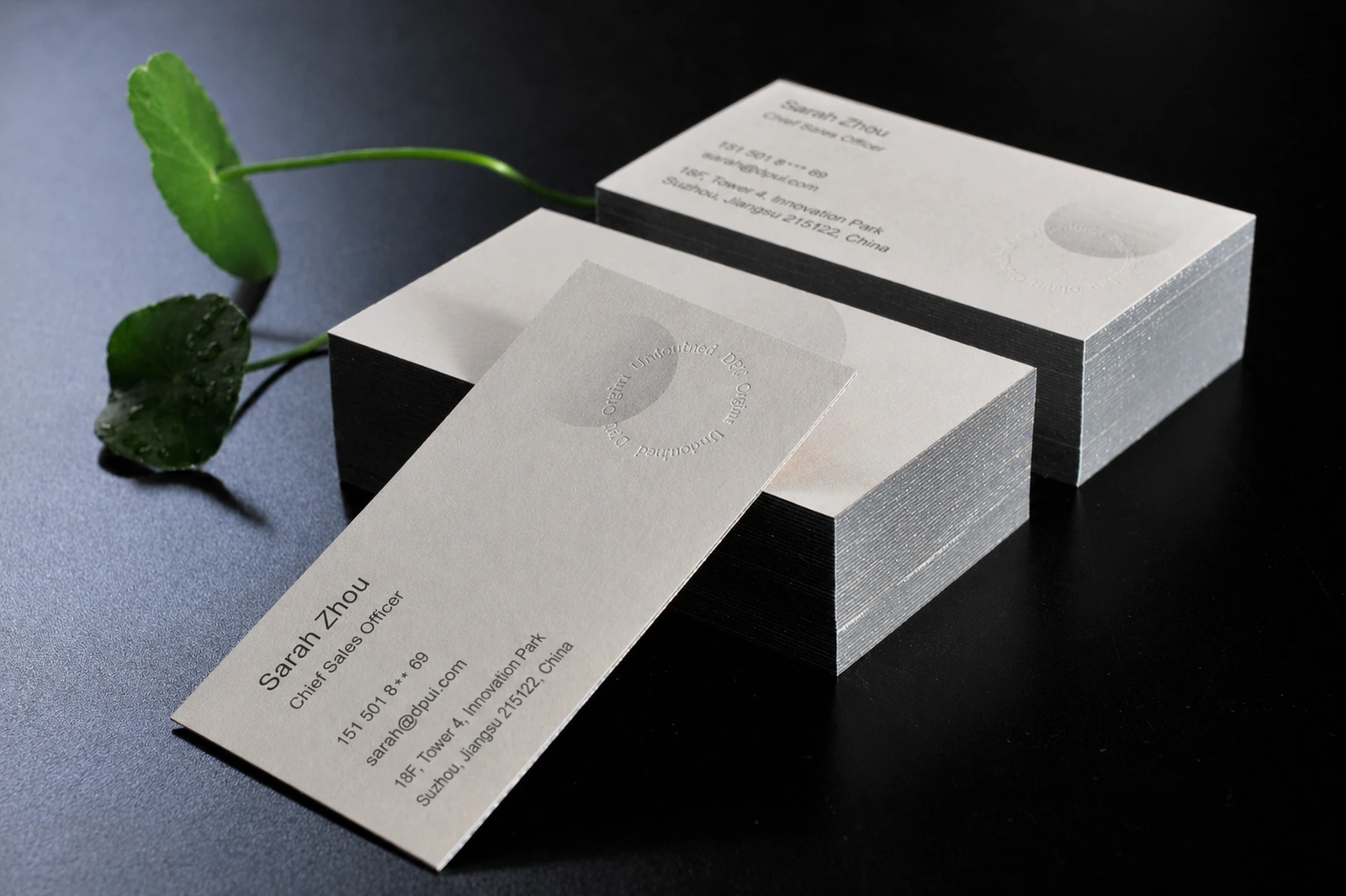
What Do Colored Edges Look Like on a Single Card?
We often hear from clients who don’t like the white edge on a standard card and want to ask about painted edges. Most of the photos they’ve seen online show dozens of cards stacked together, or a macro lens held very close. Stacked up, all those edges merge into one solid block of color, and the cards look thick and bold.
But you hand out cards one at a time. On a single card, the colored edge is only as wide as the card is thick, and the thinnest card we paint is 0.6 mm (about 0.024 in). If your card isn’t very thick to begin with, a painted edge won’t stand out much once it’s out of the stack. Many clients have told us the real card felt less striking than the photos had led them to expect.
Where Does the Line on a Color Core Card Come From?
A color core card is three sheets of paper bonded into one. The front and back sheets are the card faces and can be any color. Choose a different color for the middle sheet, and from the side you see a colored line between the two faces. We have more than 80 paper colors for the middle sheet.
Because the color is the paper itself, there’s no extra charge for it, it can’t wear off, and it can’t bleed onto the face of the card. The trade-off is that only the middle line is a different color; the front and back layers stay the color of the face papers. That line is the whole point of color core business cards, so we don’t paint the full edge on top of it. There’s one exception: if the core color you want isn’t among our 80-plus papers, we paint the edge of the middle layer in the closest shade we can get.
How Are Painted Edges Done?
If you want the entire edge in one color, it has to be painted. After the cards are printed and cut, we clamp the stack tight and brush color onto the side. It can be a single color or a gradient. We match the closest available shade rather than an exact Pantone color. Painting is an extra step, so it adds to the cost. Our guide to painted edge business cards covers more of the process.
For a metallic shine, go with foil edges instead. The stack is clamped the same way, and a layer of metallic foil is heat-pressed onto the side. You can choose from the same several dozen foil colors we use for foil business cards. The minimum thickness is also 0.6 mm, and foil edges cost extra too.
Painted edges, foil edges and color core cards all have the same minimum order and lead time: 200 cards per design, shipping in about 5 business days after you approve the digital proof.
What Can Go Wrong with Painted Edges?
Nearly every problem comes from the same thing: wet color brushed onto the cut edge of paper.
The color soaks into the paper. If the card is too thin or too soft, or the stack isn’t clamped tightly, color creeps onto the front near the edge, and it shows most on light card faces. That’s why we keep text on painted-edge and foil-edge cards at least 5 mm (about 0.2 in) from the edge.
The color also contains moisture. Thin or soft paper absorbs it, and the edge swells into a slight wave. The cards have to dry completely before they’re separated, or they stick together.
Any flaw in the cut gets magnified. An uneven cut or rough fibers stand out more once color goes on, especially with dark edges. And because the edges are brushed by hand, the pressure varies a little from stroke to stroke, so the same edge can look lighter in some spots than in others.
Once the edge is painted and fully dry, it holds up well. Carried in a wallet and handled every day, it won’t rub off.
How Should You Choose Paper and Color for Painted Edges?
Most of those problems are avoided by starting with the right paper: at least 0.6 mm thick, and stiff and dense. If the card is too thin, the edge is too narrow to show the color. If the paper is too soft, the stack can’t be clamped tightly, so the color bleeds and the edge waves. Printers set different minimums online; some say 32pt (about 0.8 mm) and up, others 700gsm and up. We can paint 0.6 mm cards, as long as the paper is stiff enough.
Pick an edge color that contrasts with the card face. Many people choose painted edges precisely to set the edge apart from the face. Dark cards look best with metallic edges such as gold or silver, for example a gold edge on black business cards. On light cards, a bright color stands out more.
Do You Need Either One If All You Want Is a Thicker Card?
No. Many people assume a three-layer card is about thickness. A single heavy sheet, or two sheets laminated into thick business cards, can reach 0.8 mm and more. Triplex business cards are worth it when you want the line in the middle, and painted edges are worth it when you want color across the whole edge. That’s the real choice behind thick business cards with colored edge detail. For when two layers suit a design better than three, see duplex vs triplex business cards.
What Did One Client Who Disliked White Edges Choose?
One of those clients wanted painted edges but was worried about the added cost. We told him plainly: painted edges look good, but on a single card they’re less noticeable than you’d expect, and most photos online are of stacks or close-ups. He went with plain white edges.
So start by asking how much the edge matters to you. If it matters and you want a colored line between the two faces, go with color core; our guide on how to plan artwork for color core business cards explains how to match the middle sheet to your brand color. If you want the whole edge in one color or a gradient, choose painted edges. For a metallic edge, choose foil edges. If the edge doesn’t matter much to you, a white edge is fine. If you’re undecided, send us your card design and the thickness you have in mind, and we’ll tell you which options work and what to watch for. You can see more papers and finishes on our luxury business cards page.